

In a world where financial stress is the norm, CA Nitin Kaushik reveals the ultimate luxury: Financial Calm. It’s not about flashy wealth or material possessions, but about having the freedom to make choices without fear or panic. Kaushik emphasizes that true financial security provides the mental space to live life intentionally, make better decisions and enjoy everyday moments without money-related stress.
Key Considerations:
Manageable fixed expenditures lower financial risk and reduce pressure to make hasty choices.
Emergency funds provide a safety net, allowing you to navigate unexpected expenses without selling investments at unfavorable times.
Sustained investment over years builds meaningful financial strength, reducing anxiety around market fluctuations.The article highlights that financial calm isn’t just a byproduct of wealth; it’s a result of careful strategic planning, reduced recurring costs and steady investment growth overtime.
By prioritizing financial stability, one can shift from reacting to fear to making intentional choices.
Achieving financial calm is more about mindset than wealth. It’s about having a plan, being disciplified and making strategic intentional decisions.
Key Practical And Strategic Tips To Get Started:
Track Your Spending: Understand where your money is going to identify areas for improvement.
Create Contingency Fund: Aim for 3-6 months’ worth of expenses to cover unexpected costs.
Automate Savings: Set up automatic transfers to your savings or investment accounts.
Prioritize Needs Over Wants: Distinguish between essential expenses and discretionary spending.
Invest Wisely: Invest strategically and systematically taking into account the investment objectives, expected rate of return (ROR), the return on investement (ROI), the market fluctuations, risks associated. Make sure to diversify your investments to grow your wealth over time.
Strategic Spending: Ask yourself if each purchase aligns with your financial goals.
Remember, financial freedom isn’t just about accumulating wealth; it’s about living a life with purpose and peace of mind.
Let’s dive deeper into creating a personalized financial plan.

A Simple Mechanism To Execute:
Assess Your Current Situation- Gather financial documents (income statements, expense reports, debt info)- Calculate your net worth- Identify financial goals (short-term, long-term, specific).
Set SMART Goals- Specific: Define clear objectives (e.g., save ₹1 lakh for a down payment).
Measurable: Track progress (e.g., save ₹10,000 per month).
Achievable: Set realistic targets.
Relevant: Align goals with values and priorities.
Time-bound: Establish deadlines.
Create a Budget- Categorize expenses (housing, transportation, food, entertainment).
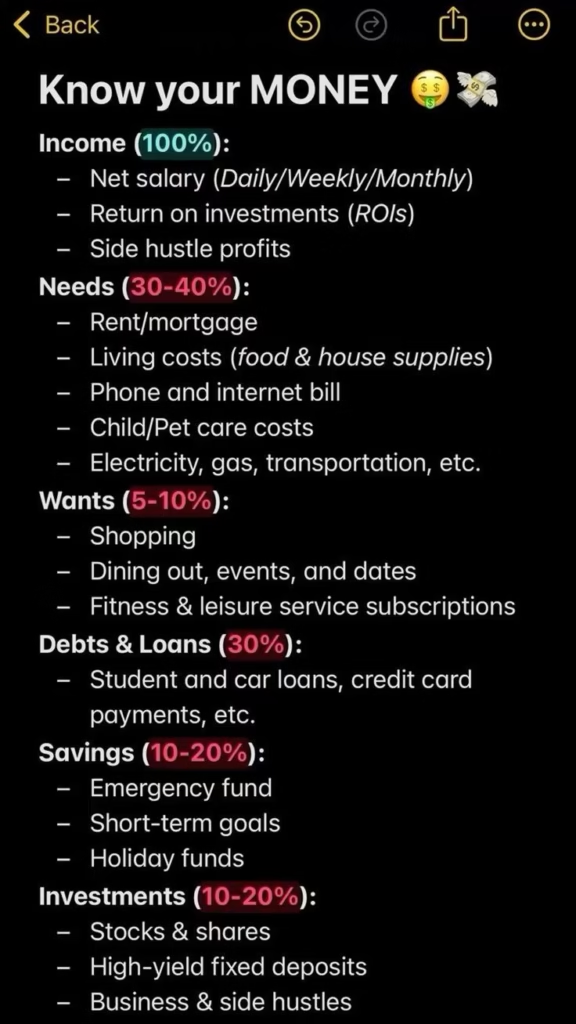
Allocate income accordingly (50-30-20 rule: 50% essential, 30% discretionary, 20% savings/debt repayment).
Manage Debt/Credit- List debts (credit cards, loans, etc.).
Prioritize high-interest debts- Consider consolidation or balance transfer options.
Build an Emergency Fund- Aim for 3-6 months’ worth of expenses- Place it in an easily accessible savings account.
Invest for the Future- Explore options (PPF, NPS, mutual funds, etc.)- Consider risk tolerance and time horizon.
Review and Adjust- Regularly review your plan (quarterly, annually)- Adjust as needed to stay on track.
What Is Investment Management?
- An individual earns and spends money throughout his or her life. There are differences between the earnings and spending of a person. This difference will lead a person either to borrow or to save to capitalise the money for the long term benefits from the income earned today.
- Investment management is the strategic and systematic process of managing a portfolio of investments to meet the estimated end goals. It involves buying and selling assets, creating investment strategies, and managing risk.
- Investment management, in simple terms, is about deciding where to put your money to grow it, and then making sure those investments are working well to meet your financial goals. It involves buying and selling things like stocks and bonds, deciding how much of your money to put into each and making sure your investments are aligned with your overall financial plan.
- “Investment management is the process of management of money including investments, budgeting, banking and taxes also called as money management.”
- Investment management as the term suggests refers to the strategic management of the excess money by effectively deploying it in various capital appreciating asset classes like, equity assets, debt instruments, corporate or government issued bonds, etc. The primary objective is to strategically and analytically make investments with the end goal of creating wealth and having a strong financial position with the minimum risks associated.
- When the income earned is more than the consumption the difference between the two is used to save. One option is to save the excess money in a cupboard until some future time when consumption exceeds current income or another option is that the person can give up the present possession of that money for a larger amount of money that will be available for the future consumption by channelizing the capital in the right avenues.
- In the Economic’s sense there is an important concept as the time value of money. Money needs to be invested by taking into consideration the percentage rate of inflation which increases on a year on year basis and if one has to beat the inflation he or she has to earn the rate of interest greater than the inflation rate.
- When the savings are made to increase the capital over a certain period of time it is known as investment. The excess money has to be invested in some financial asset to get a significant return.
- Investment, therefore, is the sacrifice of some present value for the uncertain future reward. An investment decision is a trade off between risk and return.
- Sound and strategic investments result in creation of a strong financial position and possession of a significant corpus over time. The main element when it comes to making successful, strategic, medium to long-term sound financial investments one has to maintain consistency, patience, the right approach towards things and simultaneously, keeping a check if the probable investments are working out well as per the expectations or keeping up with the estimated return on investments (ROI).
Warren Buffet, one of the most respected investors globally and the CEO & Chairman of one of the world's famous investment companies Berkshire Hathway has opined that if a person invests money in the market with even a hint of thought of selling it once the price rises is not at all an investment.
As per Sharpe, “Investment is sacrifice of certain present value for some uncertain future value.”
- The art of investment is maximizing the returns with minimum degree of risk.
- The ultimate objective is to grow and preserve wealth while minimizing risk
- An investment is said to be genuine if it has been made keeping in mind with a certain expected rate of return.
- The three important components of investment are time, inflation and uncertainty.
- Investments are generally linked to the global capital markets even though the proportions may vary as some investments are equity oriented, nevertheless, capital markets greatly influence the return on investments. Hence, investments are bound by time fluctuations in the market which makes the interest and the current inflation rate relevant within the economy.