

What is CAGR?
CAGR ia financial computation which stands for, Compound Annual Growth Rate.
The compound annual growth rate CAGR is a key financial metric used to measure the average annual growth of an investment over a specified period of time, assuming that the profits earned are reinvested back into the investment at the end of each period. It provides a rate of return that eliminate the effects of volatility and gives the consistent growth figure regardless of fluctuations and variations in the intermediate years.
CAGR, or Compound Annual Growth Rate, is a powerful metric used to evaluate the performance of investments, businesses, or any venture that grows in value over time. It’s a unique metric that takes into account the compounding effect of growth, providing a more accurate picture of returns.
CAGR is the rate of return of an investment over a specified period, taking into account the compounding effect of growth. It’s calculated by dividing the ending value of the investment by the beginning value, raising the result to the power of 1/n, where n is the number of years, and subtracting 1.
CAGR can be applied to various scenarios, such as:- Evaluating investment returns, comparing the CAGR of different investments, like stocks, mutual funds or real estate.
Formula For The Ascertainment of CAGR:
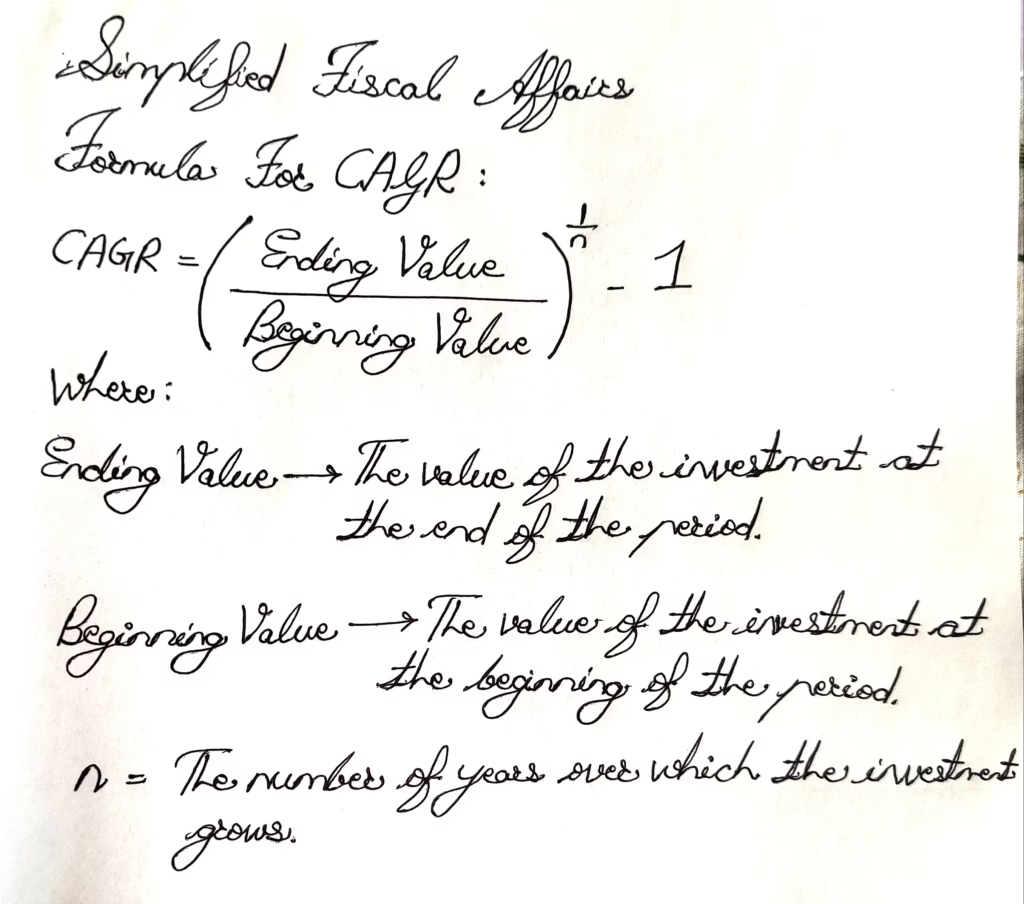
The formula for CAGR is: CAGR = (End Value / Beginning Value)^(1/n) – 1
Where,
Ending Value = The value of the investment at the end of the period or its maturity.
Beginning Value = The value of the investment at the beginning of the period or at the time of initial investment.
n = The number of years over which the investment grows.
Example: Lets say you invested ₹100,000 in a mutual fund in 2018, and it’s now worth ₹150,000 in 2023. The CAGR would be:CAGR = (150,000 / 100,000)^(1/5) – 1 ≈ 8.45%This means your investment grew at a compound annual rate of approximately 8.45% over the 5-year period.

Step Wise Computation of CAGR:
Ascertain The Beginning and Ending Values: The first and foremost step you need is the ascertainment of the initial (beginning value) of the investment and value at the end of the investment period that is the ending value.
Determine The Investment Tenure: The number of years or periods over which the investment is held needs to be taken into consideration for the accurate CAGR computation.
Apply The CAGR Formula: By substituting these values into the formula, it gives you the compound annual growth rate (CAGR).

The Uses of CAGR:
Smooths Volatility: CAGR helps smooth out the fluctuations in annual growth, offering consistent rate of return over the investment horizon. It doesn’t take into consideration the fluctuations in due course of time and gives a smooth rate of return earned.
Simplifies Comparison: By providing a single growth rate, CAGR simplifies the comparison of different investments that have varied returns in different years.
Future Forecasts: CAGR is often used to project future values, assuming the investment continues growing at the same rate.
Limitations of CAGR:
CAGR, an important financial metric provides a simple, sudden and efficient growth measure, it does not account for the fluctuations with the period of investment, its used as a steady growth rate. Hence, it might not capture the risk or fluctuations of investments that experience extreme variations on a year on year basis.

Practical Applicability of CAGR:
Investment Analysis: Potential investors use CAGR rate to evaluate the performance of stocks, mutual funds, various financial securities and investment vehicles over a period of time.
Business Growth: Businesses use CAGR to measure the growth in revenue, market share or other businesses, financial affairs in order to see where they position themselves and the scope of improvement.
Comparison: Comparison is a very common financial analysis when it comes to making the best investment. Investors use the CAGR to compare the performance of different investment opportunities or business growth rates.
Planning For The Future: Estimate future values using CAGR, helping one make informed decisions.
Why CAGR is Important?
CAGR is a useful metric because it:-
Smooths out Fluctuations: CAGR helps to iron out short-term volatility, providing a clearer picture of long-term growth.
Accounts For Compounding: CAGR takes into account the effect of compounding, which can significantly impact returns over time.
Enables Comparisons: CAGR allows for easy comparison of returns across different investments, businesses, or time periods.
Key Considerations-
Tenure: Choose a relevant time frame for calculating CAGR, as it can significantly impact the result.
Data-Driven: Ensure accurate and reliable data to calculate CAGR.
Interpretation: Consider CAGR in correlation with other metrics, like absolute returns or volatility.

CAGR In Investment Analysis:
CAGR is a valuable metric for investors, as it helps evaluate the performance of investments over time. Here are some key aspects to consider:
Comparing Investments: CAGR enables comparison of returns across different investments, such as stocks, mutual funds or real estate.
Long-Term Focus: CAGR encourages a long-term perspective, helping investors ride out market fluctuations.
Compounding Effect: CAGR takes into account the powerful effect of compounding, which can significantly impact returns over time.
Calculating CAGR for Different Scenarios:
CAGR can be applied to various investment scenarios, such as:
Lum Sum Investment: Calculate CAGR for a single investment made at the beginning of the period.
SIP (Systematic Investment Plan): Calculate CAGR for regular investments made at fixed intervals.
Multiple Investments: Calculate CAGR for multiple investments made at different times.
CAGR vs. Other Metrics:
CAGR is just one metric; consider it alongside others, such as:
Absolute Returns: Total return over a period, without considering time.
Annualized Returns: Average return per year, without considering compounding.
XIRR (Extended Internal Rate of Return): A more complex metric that accounts for multiple cash flows.

Real-World Applications:
CAGR has practical applications in:
Retirement Planning: Estimate future corpus using CAGR, helping you plan for retirement.
Goal-Based Investing: Use CAGR to calculate the required investment amount for specific goals, such as buying a house or funding education.
Portfolio Evaluation: Evaluate the performance of your investment portfolio using CAGR.