
Running a successful business is quite a structural framework and needs to be system driven to optimise and strategically execute the various business activities accurately. Companies following a proper plan of action in terms of its procedures are quite successful and carry a great reputation, have better relations with its stakeholders and shareholders. Data and system driven systems rarely fail, hence, businesses strictly work under a strategic code of conduct and reach their targeted heights with quite ease compared to its peers.
All the procedures once executed with a strategic framework, the tasks get accurately done!

Corporate Governance is the strong foundational base prevalent within all business organisations. It is an element of atmost importance which helps businesses function seamlessly, efficiently, structurally and carry out its regular activities like company rules, legal compliance, stakeholders satisfaction, etc.
Corporate governance refers to the process of the affairs of the company which are managed in regards to the fairness, honesty and good practices for the benefit of all stakeholders of the company. This is to be done with a systematic structure, quite well formulated policies and procedures, taking into consideration the vital points of companies like the balance between the interest of various stakeholders.
Corporate governance is the system of rules, practices and processes that directs and controls a company, making sure it operates ethically and in the best interests of all the company’s stakeholders, such as shareholders, employees and customers. It is often guided by a corporate code of conduct that establishes corporate principles like fairness, transparency and accountability, providing a framework for leadership, decision-making and relationships with shareholders and other parties.

In order to qualify a good governed company, a company has to put in place the mechanism of its functioning with its various checks in regards to the balances between the stakeholders, directors, auditors and the management at large. The process of corporate governance is more a way of business life than just the legal compliance and rules. Companies are forced to comply with the conditions by adopting the legal prescription as some companies may not function in the desired ethical manner, hence, it is quite mandatory for companies to follow a strict corporate governance framework.
There should be uniformity in corporate governance so that the various stakeholders of the company can compare between similar companies and reach better conclusions.
Corporate governance as the name suggests is a kind of governance which has come into picture to have a set of structured standard obligations of ethics towards companies to secure the stakeholders.
Various Management Scientists and Philosophers Define Corporate Governance:
Nobel Laureate Milton Freidman, "Corporate governance is the conduct of business in accordance with the shareholder desire, which generally means to make money as much as possible, while contributing to the basis rules of society embodied in law and local customs."
Adrian Cadbury (The Chairman of the Cadbury Committee), " Corporate governance is a system by which companies are directed and controlled. It has to do with power and accountability, who exercises in whose behalf and how."
Narayan Murthy Committee (The Chairman of the Corporate Governance Committee), "Corporate governance is the acceptance of the non alienable rights of the shareholders as true owners of the corporation and their own roles as trustees. It is about commitment of values, ethical business conduct and differentiating between personal and corporate fund."
Gradually, in due course of time, with the growth of commerce and trade, businesses and the economy, currently, have a stronger interface. From the typical concept of profit being the core element of the business, now we are in a position where the stakeholder definition consists of not only the shareholder but the employees, society, customers, suppliers, creditors, investors, the Government, etc. This is a paradigm shift in the corporate management from the traditional ‘management’ concept to the ‘governance’ concept.
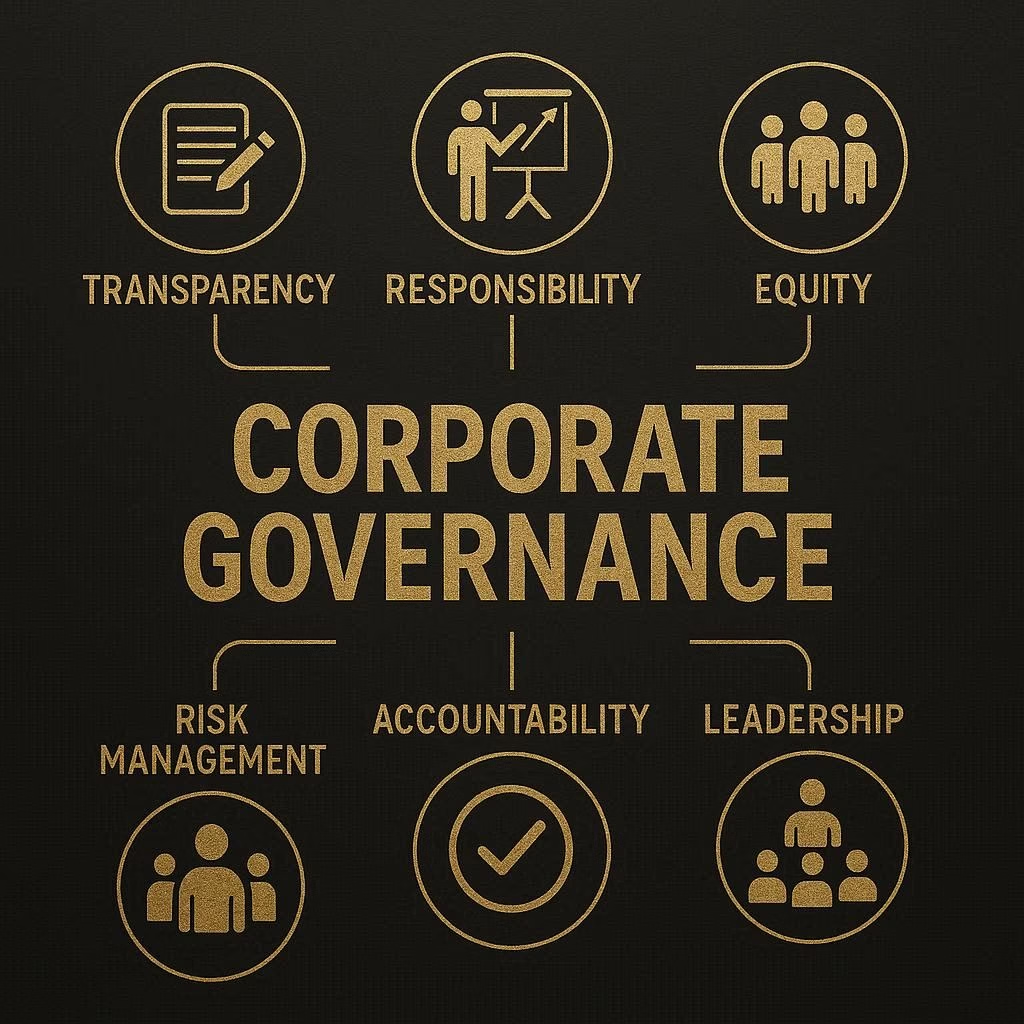
Objectives of Corporate Governance:
- Company to justify and satisfy the various stakeholders by balancing the conflict of interest among the stakeholders.
- Company adopts transparent, logical, justifiable policies which are structurally and efficiently sound in regards to the stakeholders in all the areas of the management and company.
- Ideal composition of the board of directors to justify independence in decision making.
- Optimum allocation of resources of the company as the resources belong to the shareholders and their after the employees; customers, investors are at large affected if the resources available are not properly utilised.
- To reduce risks by following and adapting appropriate risk management systems through due diligence procedures.
- Establishing strong relationships between the company and its various stakeholders which further enhances the value of the company and creates goodwill.
Features of Corporate Governance:
Ensuring Transparency: The complete disclosure of the state of affairs of the company at every single step to the stakeholders is required to maintain transparency. This concept goes against the theory of separation of material facts by the company to its stakeholders.
Prudent and Participative Management: The management must make sure to use all the available information and knowledge for the benefit of the stakeholders of the company. Therefore, it may be taken that management is prudent and wise in its decision making.
Value Creation: Creating value is the most important bullet/target for any business organisation. Stakeholders expect companies to grow on an year on your basis. Value includes monetary or non-monetary reputation, image, goodwill, creditworthiness etc . Companies with better corporate governance will have better reputation, trust of the stakeholders and there will be enhancement and growth of business leading to higher profits and a better enterprise valuation.
Accountability: Success and accountability are the two elements which go together. Higher success definitely comes with higher accountability. According to Professor, Henry Fayol, the director of the 14 Principles of Management, has stated that ‘Authority comes with Responsibility’ as in the authoritative successful position comes up with the corresponding responsibility or accountability. The company cannot say it is accountable to one stakeholder only it has to be accountable to all the stakeholders at large.
Innovation: Growth is a factor which needs innovation and evolution. Doing something new or doing the same thing in a novel manner is the essence of growth and sustainability of a business. The governance structure should encourage new things in the company for enhancing value of the company.
Innovation In The World of Business is the driving force which creates many new businesses, new opportunities for entrepreneurs who fill the gap between the consumer wants and the direct inefficiencies. Innovation is the gap filling element between what is required and what is not provided for/met. The businesses which know it directly or indirectly become successful in filling those gaps and further create massive success.
Professionalism and Specialisation: The basics of professionalism is that the job shall not compromise at any level and there should not be conflict of interest of the internal management. It also takes into account the competence of the person doing the job having obvious adequate domain knowledge either by academic qualification or track record of experience.
Professionalism is a vital element when it comes to the company’s internal management. Having a professional attitude helps the company to maintain its relations with its stakeholders and the government and taxation authorities.
Stakeholder Recognition: The stakeholders are owners of the company, the top management must make sure to give respect and recognition to its stakeholders. They are the investors who believe in the company and standby it. All stakeholders should be recognised and respected well. The company should firmly believe that all the stakeholders have a certain level of contribution in making the company attain success in the present and years to come.

The Emergence And Evolution of Corporate Governance:
- Instances of corporate failures, last two decades have considerably witnessed various corporate failures of some of the reputed and large companies which has resulted to mistrust by the stakeholders of these companies in general.
- Big failures primarily include certain level of scams, fraudulent business practices done by companies with an ulterior motive.
- Rise of institutional investors who are bothered about the company and investment. They need a clear framework and blueprint in regards to the company’s financial statements and its direct corporate governance.
- Increase in number of retail investors who want accurate financial and company information.
- Regulatory requirements, legal and tax compliance apply on ethical and governance issues.
- Justifying the core value proposition to wide range of stakeholders.
- Non complaints of regulations become a vital disadvantage in assessment of corporate governance level. By not implementing efficient corporate governance standards the company can face a major backlash in terms of its reputation, stakeholder confidence, profitability, growth, sustainability, shareholder value, stock exchange valuations and an uncertain future.
- Disconnect with the stakeholders is considered to be a bad practice.
- High fluctuation and volatility in share prices give rise to speculation about good and bad management practices and outsiders are interested to know about the happenings of the company.
Benefits of Corporate Governance:
- A better governed company is essential for growth, sustainability and future profitability.
- Reputation of the company will exponentially expand, once people know that you are honest or a good company. The company is primarily expected by its shareholders to function in a true and fair manner.
- Better capital and fund allocation.
- Better management of the resources which are available to the company.
- Better governed in short & long term and steady growth with enhance future profitability and stakeholder confidence.
- Establishing stakeholder and shareholder confidence.
- Leverage of competitive advantage.
- A company following a great structurally sound corporate governance framework stands out from its peers.
- Alliances with other companies are easy as others are interested to be associated with your company.
Thanks for sharing. I read many of your blog posts, cool, your blog is very good.
Simplified Fiscal Affairs really appreciates that, it gives us immense motivation and inspiration to keep moving forward and to come up with the best possible content.
Your article helped me a lot, Thanks!
Simplified Fiscal Affairs really appreciates that, it gives us immense motivation and inspiration to keep moving forward and to come up with the best possible content.
Your point of view caught my eye and was very interesting. Thanks.
Your article helped me a lot! Thanks!
“Thank you for your very generous appreciation. Your comments are always welcome and valued.”