
Depreciation vs Amortization: Understanding the Difference Between Two Essential Accounting Concepts
In accounting, businesses often invest in assets that provide economic benefits over several years. However, the cost of these assets is not always recognised as an expense in a single accounting period. Instead, it is systematically allocated over their useful lives through two important accounting concepts: Depreciation and Amortization.
Although both concepts serve a similar purpose, they apply to different categories of assets and have distinct accounting considerations.

1. What Is Depreciation?
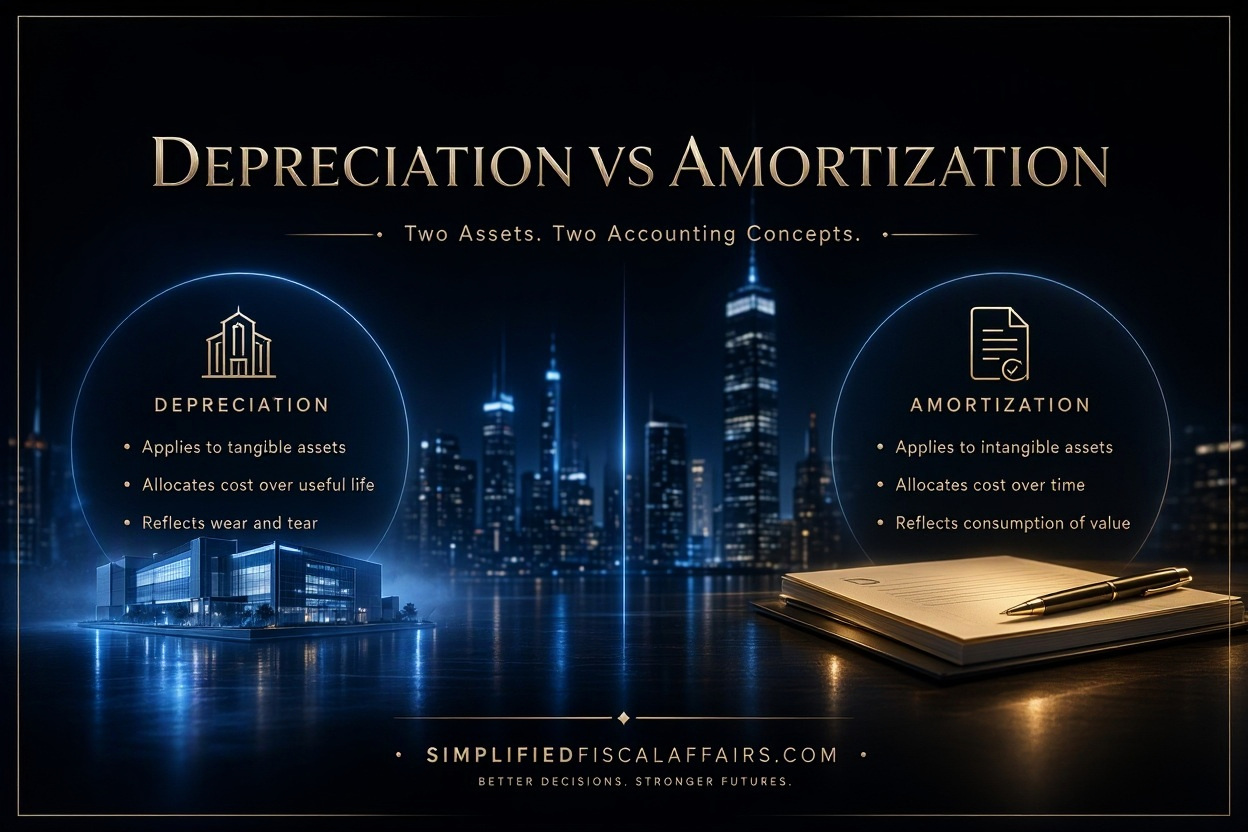
Depreciation is the systematic allocation of the depreciable amount of a tangible fixed asset over its useful life.
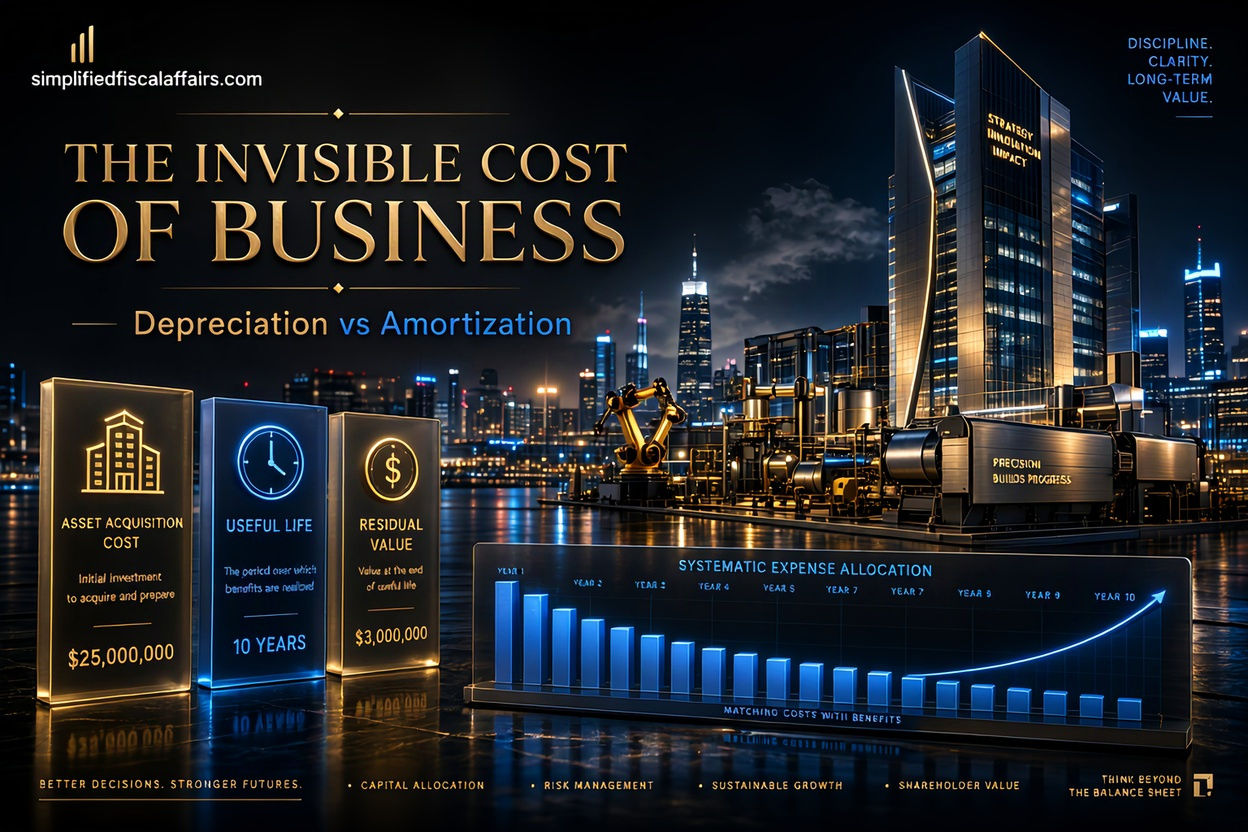
In simple terms, when a business purchases machinery, vehicles, buildings or equipment, these assets generally provide benefits for several years. Rather than charging their entire purchase cost as an expense immediately, the business allocates the cost over the periods in which the assets are expected to be used.
Example:
Suppose a manufacturing company purchases machinery for ₹10,00,000, with an estimated useful life of 10 years and a residual value of ₹1,00,000.
Using the straight-line method:
Annual Depreciation = (Cost − Residual Value) ÷ Useful Life
Annual Depreciation = (₹10,00,000 − ₹1,00,000) ÷ 10
Annual Depreciation = ₹90,000
The company recognises ₹90,000 as depreciation expense every year, assuming the estimates and method remain unchanged.
Common examples of depreciable assets include:
- Buildings and factories
- Machinery and equipment
- Vehicles
- Furniture and fixtures
- Computers and office equipment
2. What Is Amortization?
Amortization is the systematic allocation of the depreciable amount of an intangible asset over its useful life.
Unlike depreciation, which generally applies to physical assets, amortization primarily deals with assets that do not have a physical form but provide economic benefits to a business.
Example:
Suppose a technology company purchases a software licence for ₹5,00,000, with an estimated useful life of 5 years and no residual value.
Using the straight-line method:
Annual Amortization = Cost ÷ Useful Life
Annual Amortization = ₹5,00,000 ÷ 5
Annual Amortization = ₹1,00,000
The company recognises ₹1,00,000 as amortization expense annually, assuming the licence has a finite useful life and the estimates remain unchanged.
Common examples of intangible assets subject to amortization include:
- Patents
- Copyrights
- Software licences
- Certain trademarks
- Customer relationships
- Other identifiable intangible assets with finite useful lives
Important: Not every intangible asset is amortized. Intangible assets with indefinite useful lives are generally not amortized but are tested for impairment under the applicable accounting standards.


3. Depreciation vs Amortization: Key Differences
| Basis | Depreciation | Amortization |
|---|---|---|
| Meaning | Allocation of asset cost over its useful life | Allocation of intangible asset cost over its useful life |
| Asset type | Tangible assets | Intangible assets |
| Physical existence | Physical assets | Non-physical assets |
| Examples | Machinery, buildings, vehicles | Patents, software, copyrights |
| Residual value | Generally considered | Often assumed to be zero unless specific criteria are met |
| Methods | Straight-line, reducing balance, units of production | Generally straight-line, or another systematic method reflecting the consumption pattern |
| Impairment | Subject to applicable impairment requirements | Subject to applicable impairment requirements |

4. Understanding the Accounting Treatment
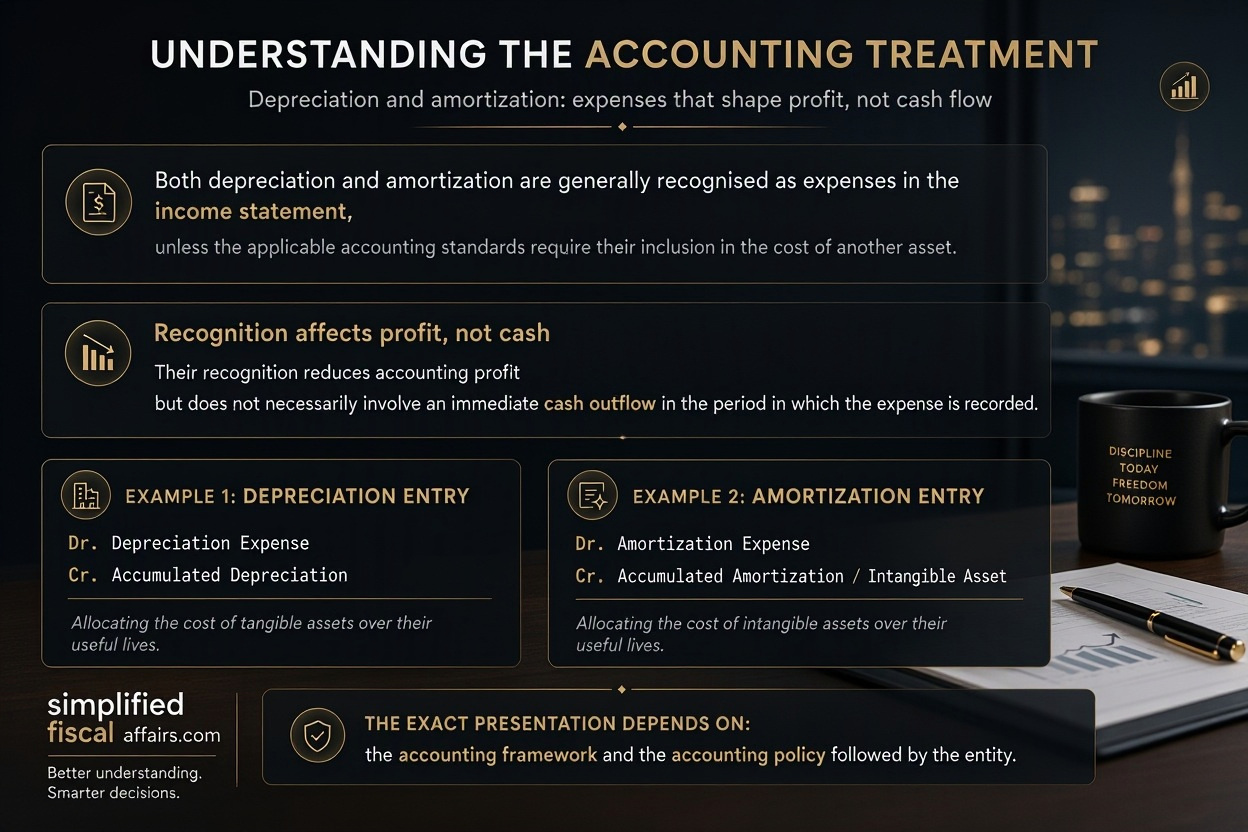
Both depreciation and amortization are generally recognised as expenses in the income statement, unless the applicable accounting standards require their inclusion in the cost of another asset.
Their recognition reduces accounting profit but does not necessarily involve an immediate cash outflow in the period in which the expense is recorded.
For example:
Depreciation Entry:
Dr. Depreciation Expense
Cr. Accumulated Depreciation
Amortization Entry:
Dr. Amortization Expense
Cr. Accumulated Amortization / Intangible Asset
The exact presentation depends on the accounting framework and the accounting policy followed by the entity.

5. Advanced Perspective: Impact on Financial Statements and Financial Analysis
Depreciation and amortization are particularly important in financial reporting, valuation and investment analysis.
A. Impact on the Income Statement
Both expenses reduce reported operating profit or profit before tax, depending on their classification.
B. Impact on the Balance Sheet
Depreciation reduces the carrying amount of tangible assets through accumulated depreciation. Amortization reduces the carrying amount of finite-life intangible assets.
C. Impact on Cash Flow
Both are generally non-cash expenses. Under the indirect method of preparing the cash flow statement, they are added back to profit when reconciling accounting profit to operating cash flow.
D. Impact on EBITDA
EBITDA stands for Earnings Before Interest, Taxes, Depreciation and Amortization.
Since both expenses are excluded from EBITDA, analysts often use this measure to examine operating performance before these accounting charges.
However, EBITDA does not represent actual cash flow and should not be treated as a complete measure of business profitability.
E. Impact on Business Valuation
Depreciation and amortization assumptions can influence reported earnings, asset values and financial projections. Analysts therefore examine useful lives, residual values, amortization periods and impairment indicators when evaluating a company’s financial performance.

6. Key Takeaways
- Depreciation relates primarily to tangible fixed assets.
- Amortization primarily relates to intangible assets with finite useful lives.
- Both systematically allocate asset costs over relevant periods.
- Both generally reduce accounting profit without creating an equivalent immediate cash outflow.
- Both are important in financial reporting, financial analysis and business valuation.
Conclusion
Depreciation and amortization may appear similar because both distribute asset costs over time, but they address two different dimensions of business investment: physical infrastructure and intangible economic resources.
Understanding the distinction is essential for accountants, auditors, financial analysts, investors and business managers because the appropriate recognition of these expenses contributes to more meaningful financial statements and better-informed economic decisions.
Simplified Fiscal Affairs — Beyond the Headlines. Beneath the Numbers. Understanding the Forces That Shape Global Finance.

Educational disclaimer: This article is intended for general financial education and awareness. It does not constitute investment advice or a recommendation to buy or sell securities. Any companies, organizations, financial institutions, individuals, financial data or scenarios mentioned are used for explanatory or illustrative purposes unless explicitly identified as publicly documented cases. Documentary-style narratives, hypothetical examples, and reconstructed investigative scenarios are intended to help readers understand forensic auditing concepts and should not be interpreted as factual accounts of any specific ongoing investigation.
The information presented does not constitute legal, accounting, auditing, financial, investment, or professional advice. While every effort has been made to ensure accuracy, readers should consult qualified legal, accounting, forensic, or financial professionals before making decisions based on the information contained in this article.