
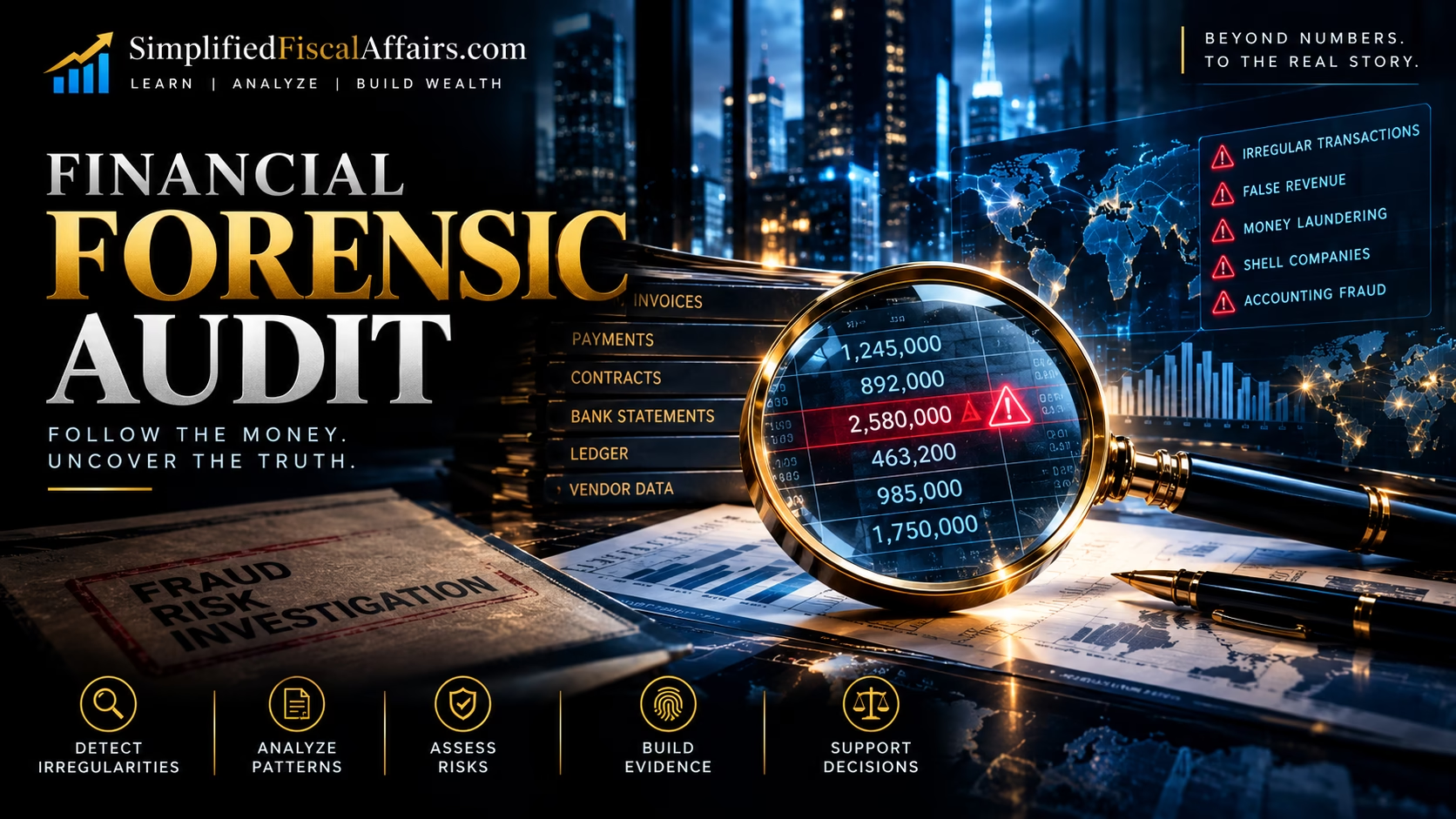
Forensic Audit is a meticulous and thorough examination of financial records and transactions to uncover a potential fraud, embezzlement, or other financial irregularities. It’s a specialized field that combines accounting, auditing, and investigative skills to uncover the truth behind financial discrepancies.
A forensic audit is a detailed examination of a company’s financial statements, transactions, and records to detect and investigate potential financial malpractices. It’s a comprehensive review of financial data, often conducted in response to suspected fraud, corruption or other financial irregularities.
Forensic audits can be conducted on various types of organizations, including corporations, non-profits and government agencies.

FINANCIAL FORENSIC AUDIT
Beyond the Numbers. Uncovering the Truth.
Financial fraud rarely announces itself. It hides in duplicate payments, manipulated journal entries, concealed relationships, unusual transaction patterns and digital footprints buried within millions of records.
Financial Forensic Audit transforms financial data into investigative evidence. By combining accounting expertise, analytical techniques, digital forensics and professional skepticism, it traces the flow of money, identifies suspicious patterns, reconstructs transactions and helps uncover the truth behind financial irregularities.
Unlike routine financial reviews, forensic auditing asks a deeper question: Does the evidence support the story the numbers are telling?
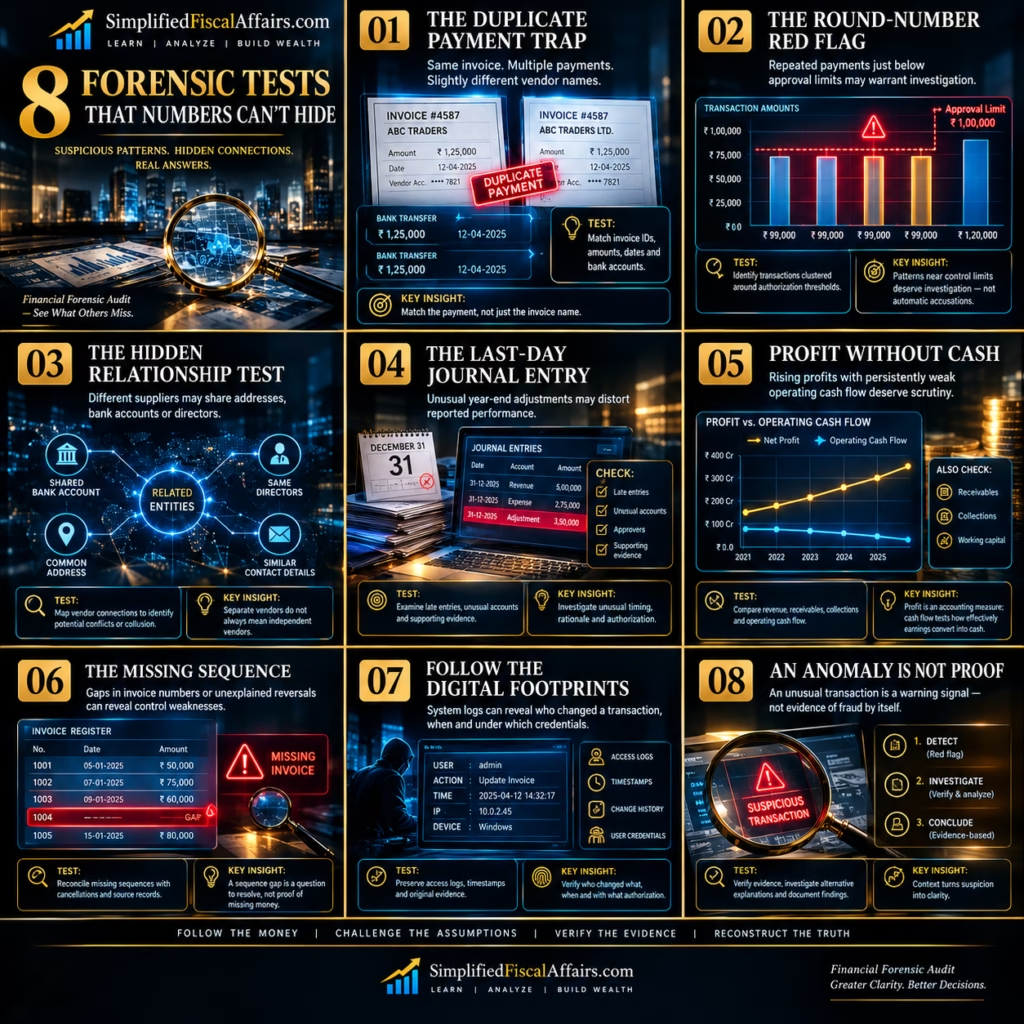
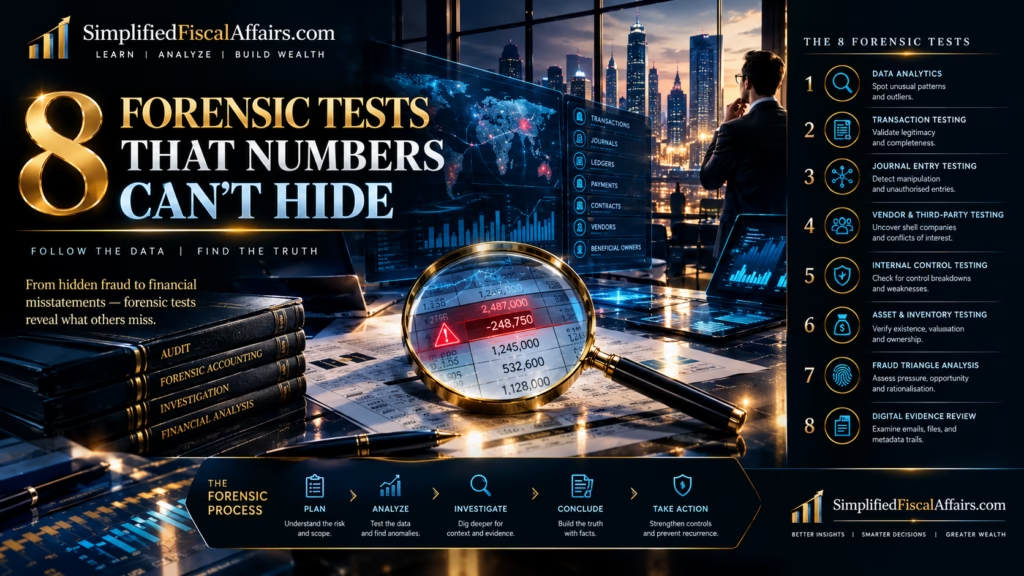
8 FORENSIC TESTS THAT NUMBERS CAN’T HIDE
1. THE DUPLICATE PAYMENT TRAP
Same invoice, multiple payments, slightly different vendor names.
Test: Match invoice IDs, amounts, dates and bank accounts.
2. THE ROUND-NUMBER RED FLAG
Repeated payments just below approval limits may warrant investigation.
Test: Identify transactions clustered around authorization thresholds.
3. THE HIDDEN RELATIONSHIP TEST
Different suppliers may share addresses, bank accounts or directors.
Test: Map vendor connections to identify potential conflicts or collusion.
4. THE LAST-DAY JOURNAL ENTRY
Unusual year-end adjustments may distort reported financial performance.
Test: Examine late entries, unusual accounts and supporting evidence.
5. PROFIT WITHOUT CASH
Rising profits with persistently weak operating cash flow deserve scrutiny.
Test: Compare revenue, receivables, collections and operating cash flow.
6. THE MISSING SEQUENCE
Gaps in invoice numbers or unexplained reversals can reveal control weaknesses.
Test: Reconcile missing sequences with cancellations and source records.
7. FOLLOW THE DIGITAL FOOTPRINTS
System logs can reveal who changed a transaction, when and under which credentials.
Test: Preserve access logs, timestamps and original evidence.
8. AN ANOMALY IS NOT PROOF
An unusual transaction is a warning signal—not evidence of fraud by itself.
Test: Verify evidence, investigate alternative explanations and document findings.
Importance of Forensic Audit:
Forensic audits play an integral role in the regular corporate affairs like:
Detecting Financial Crimes: Forensic audits help identify and investigate financial irregularities, such as embezzlement, money laundering, or accounting fraud.
Preventing Financial Losses: By detecting potential fraud early, companies can take steps to prevent further losses and protect their assets.
Ensuring Regulatory Compliance: Forensic audits help companies comply with regulatory requirements and industry standards.
Protecting Stakeholders’ Interests: Forensic audits provide stakeholders, including investors and shareholders, with assurance that financial statements are accurate and reliable.

PRACTICAL FORENSIC INVESTIGATION WORKFLOW
From Suspicion to Evidence-Based Conclusions
STEP 1 — IDENTIFY THE RED FLAG
Detect unusual payments, unexplained adjustments, duplicate invoices or inconsistent financial patterns.
STEP 2 — PRESERVE THE EVIDENCE
Secure original records, transaction logs, emails and supporting documents. Maintain a documented chain of custody.
STEP 3 — TRACE THE MONEY
Follow transactions across invoices, bank statements, ledgers, vendors and related accounts to reconstruct the flow of funds.
STEP 4 — TEST THE HYPOTHESIS
Use data analytics, reconciliations, document verification and independent corroboration to test suspected irregularities.
STEP 5 — ESTABLISH THE FACTS
Determine what happened, who had access or authorization, the financial impact and whether alternative explanations exist.
STEP 6 — REPORT AND RECOMMEND
Document verified findings, quantify supported losses where possible, explain control weaknesses and recommend corrective action.
THE INVESTIGATIVE LOGIC
RED FLAG → EVIDENCE → TRANSACTION TRACE → VERIFICATION → FINDINGS → ACTION
Professional principle: Suspicion initiates an investigation. Corroborated evidence supports its conclusions. An anomaly alone does not prove fraud.
THE FORENSIC PRINCIPLE
Follow the money. Challenge the assumptions. Verify the evidence. Reconstruct the truth.
SimplifiedFiscalAffairs.com
Learn | Analyze | Build Wealth

Disclaimer
This article is published solely for educational, informational, and public awareness purposes. Any companies, organizations, financial institutions, individuals, financial data or scenarios mentioned are used for explanatory or illustrative purposes unless explicitly identified as publicly documented cases. Documentary-style narratives, hypothetical examples, and reconstructed investigative scenarios are intended to help readers understand forensic auditing concepts and should not be interpreted as factual accounts of any specific ongoing investigation.
The information presented does not constitute legal, accounting, auditing, financial, investment, or professional advice. While every effort has been made to ensure accuracy, readers should consult qualified legal, accounting, forensic, or financial professionals before making decisions based on the information contained in this article.
SimplifiedFiscalAffairs.com does not make any allegations against any person, company, or institution, nor does it endorse or condemn any entity referenced. References to publicly known corporate frauds or legal cases are based on information available in the public domain and are included solely for educational analysis.
The publisher and author disclaim any liability for actions taken based on the contents of this article.