

WHAT IS A CONTINUOUS AUDIT?

- Audit that remains continue throughout the financial year is known as the continuous audit.
- The auditor checks each and every transaction. The large scale business organisations require constant check of their business matters, as there may be declaration of dividend, during the year.
- In case of a company, where the volume of transactions is quite large, the management can follow the policy of applying continuous audit.
- If the internal control systems prevalent in the organisations are not satisfactory, then to apply continuous audit will be the best option in order to represent a true and fair view of the organisation.
R.G. Williams says that continuous audit is one where the auditor or his staff is consistently engaged in checking the accounts during the whole period, or where the auditor or his staff, attend at regular or irregular intervals during the period.

Advantages:
- Thorough check: The primary advantage of the continuous audit is thorough checking. The audit staff remains busy throughout the year, as each and every transaction is reviewed in detail.
- Quick detection of errors: As the auditor checks the transactions, in detail, at regular intervals there is quick detection of errors.
- Timely presentation of accounts: As most of the checking work is already performed during the year, the final audit can be presented on a timely basis to the shareholders, after the close of the financial year at the annual general meeting.
- Prompt filing of returns: The continuous audit proves beneficial for the quick filing of returns as the accounts are prepared as well as audited at the end of the year.
- Interim dividend: The continuous audit proves to be helpful for the declaration of the interim dividend.
- Moral check on the client’s staff: The continuous audit is useful to develop moral check on employees. As the time between recording and checking is quite short, the staff cannot think to plan any frauds. The auditor at times may surprisingly visit the client’s office, therefore, it will have a considerable moral check.
- Convenient for auditor: The continuous audit is helpful for the audit staff for distribution of work, for the whole year. The audit staff can prepare the programme on the basis of time allocated. The auditor gets sufficient time for important and suspicious matters to draw conclusion.

Disadvantages:
- Small entity: The continuous audit is not fit for small scale business organisations since it has fewer transactions.
- Expensive: It is not suitable for small business organisations with less financial transactions, as the continuous audit is an expensive system of audit.
- Alterations of figures: Figures in the books of accounts which have already been checked by the auditor, may be altered by a dishonest employee and frauds may be committed.
- Disturbance at work: The frequent visits by the auditor may disturb the work of the client. When the audit work starts, the work of accounting staff suffers, as the books are not spare.

The Corporate Efficiency Through Continuous Audit Execution
Continuous audit represents a fundamental strategic shift from traditional periodic auditing towards a system-driven, real-time assurance process that leverages advanced information technology to provide ongoing verification of financial and operational data integrity.
Conceptually, continuous auditing eliminates the temporal gap between the occurrence of business events and the issuance of an auditor’s opinion on their fairness and accuracy . This strategic and systematic evolution is driven by the digital economy’s demands for real-time financial reporting and the increasing complexity of electronic business transactions, which have rendered conventional manual audit approaches inadequate for modern risk management needs.
The core mechanism of continuous auditing involves embedding automated controls, analytical procedures, and monitoring mechanisms directly within organizational information systems to continuously collect, analyze and report on transactional data throughout the accounting period.
Unlike traditional audits that sample/study historical data at discrete intervals, continuous auditing provides comprehensive coverage through systematic evaluation of all relevant transactions. This strategy enables early detection of errors, fraudulent activities, control deficiencies and compliance violations, thereby transforming auditing from a retrospective verification exercise into a proactive risk management and supervision tool.

The distinctive value proposition of continuous auditing lies not merely in its frequency but in its ability to generate insights that are structurally impossible to obtain through conventional sampling-based retrospective methods.
The most significant benefit of continuous auditing is its capacity for immediate fraud detection. Traditional audits typically examine transactions after they have been aggregated, processed and reported, often missing subtle patterns of fraudulent activity that sophisticated perpetrators deliberately structure to avoid detection thresholds.
Continuous auditing systems, by contrast, can monitor 100% of transactional data in real-time, applying sophisticated and efficient systems to identify unusual patterns, duplicate payments, unauthorized access, or control failures at the moment they happen. This proactive detection capability was demonstrated in the Brazilian Navy payroll implementation, where continuous auditing enabled internal auditors to identify discrepancies by cross-referencing personnel data with external government databases, significantly improving audit quality and timeliness.
A second advantage is the dynamic risk assessment capability that continuous auditing provides through constant monitoring of control effectiveness. Rather than relying on static risk assessments conducted annually or quarterly, continuous auditing generates ongoing intelligence about how well internal controls are functioning in real operational environments. This creates a living risk map that reflects actual business conditions rather than theoretical assumptions. The hospitality industry study in Ecuador revealed that continuous audit implementation led to “revealing benefits” in risk management precisely because it allowed organizations to adapt their control strategies based on real-time performance data rather than lagging indicators.
Continuous auditing, by analyzing complete populations of transactions, removes this systematic blind spot and provides assurance over the entire dataset rather than just a representative subset. This comprehensive coverage is particularly valuable in detecting low-frequency, high-impact fraud schemes that perpetrators specifically design to fall below traditional sampling thresholds. The three-layer continuous auditing system proposed by Kyunghee Yoon, Yue Liu, and Tiffany Chiu (often with Miklos Vasarhelyi), demonstrates how complete data analysis can be structured to manage alarm fatigue while maintaining comprehensive coverage, classifying and aggregating journal entries using defined rules before escalating only truly exceptional transactions for manual review.

Enhanced auditor-client collaboration through automated exception reporting and interactive dashboards constitutes another unique informational benefit. Continuous auditing transforms the traditionally reserved/awkward audit relationship into a collaborative partnership by providing both parties with shared visibility into control performance and risk indicators.
Perhaps most strategically valuable is the forward-looking insight capability that continuous auditing enables through trend analytics and predictive modeling. While traditional audits provide backward-looking assurance about historical financial statements, continuous auditing can identify emerging risk patterns, predict potential control failures and forecast financial frauds before they materialize. By applying system driven automation to historical transaction patterns, continuous auditing systems can establish baseline behavioral models and flag deviations that may indicate future problems.
This predictive capability transforms auditing from a compliance function into a strategic risk management, excellence execution and operational efficient partner that contributes to organizational resilience and competitive advantage.
Advantages of continuous auditing are not just beneficial but essential for ensurig effective corporate governance and stakeholder confidence.
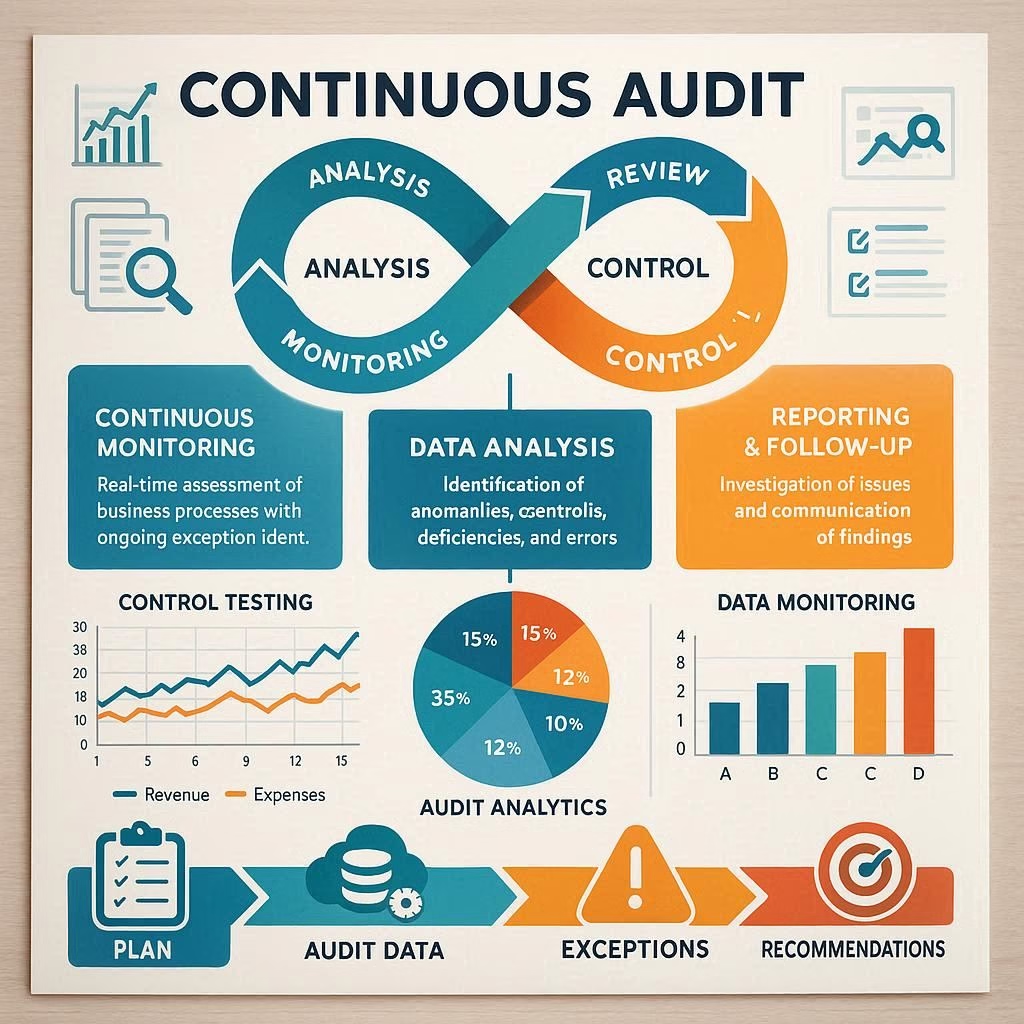
In conclusion, continuous auditing delivers exceptional benefits that fundamentally differentiate it from traditional audit approaches. These benefits—immediate fraud detection, dynamic risk assessment, elimination of sampling bias, enhanced collaboration through transparent reporting, and futuristic predictive insights—collectively create a more robust, relevant and valuable assurance service. However, realizing these benefits requires sustained commitment to implementation excellence, appropriate technological infrastructure and organizational readiness for transformation.