

How Credit Rating Agencies Measure Risk and Why AAA Is Different from Junk Bonds
“In the bond market, the biggest question is not ‘How much interest will I earn?’ The biggest question is ‘Will I get my money back?’ Credit ratings exist to help answer that question.”

Introduction: Every Loan Begins with Trust
Imagine two people approach you asking for a loan of ₹10 lakh.
The first person has a stable career, an excellent repayment history, modest existing debt, and a consistent income.
The second person has missed several loan payments, carries significant debt, and has no reliable source of income.
Both promise to pay you 8% interest.
Would you lend to both on the same terms?
Most people would hesitate.
You would naturally ask a simple but critical question:
“How likely is each borrower to repay me?”
The global bond market asks exactly the same question.
Whether the borrower is a government, a multinational corporation, or a local municipality, investors want to understand one thing above all else:
What is the probability that this borrower will meet its financial obligations?
Credit ratings were developed to provide a standardized answer.

Why Credit Ratings Matter
Every bond carries some degree of risk.
Even governments and globally recognized corporations can experience financial stress.
Investors therefore need a consistent framework for comparing thousands of different issuers around the world.
Credit ratings serve as an independent opinion about an issuer’s ability to repay debt according to its contractual terms.
They help investors:
- Compare borrowers.
- Assess credit risk.
- Estimate appropriate yields.
- Build diversified portfolios.
- Comply with investment policies and regulations.
Importantly, a credit rating is not a guarantee. It is an informed assessment based on available information and analytical judgment.
What Is Credit Risk?
Credit risk is the possibility that a borrower may fail to make promised interest payments or repay the principal at maturity.
This can occur for many reasons:
- Weak cash flows.
- Economic recessions.
- Poor financial management.
- Industry disruptions.
- Political instability.
- Unexpected crises.
The higher the perceived credit risk, the more compensation investors generally demand in the form of higher yields.
This relationship lies at the heart of bond pricing.

The Three Major Global Credit Rating Agencies
Over time, specialized organizations emerged to evaluate the creditworthiness of borrowers.
The three most widely recognized agencies are:
- Moody’s Ratings
- S&P Global Ratings
- Fitch Ratings
Although each agency uses its own methodology and rating symbols, their overall objectives are similar:
To assess the likelihood that borrowers will meet their debt obligations.
Investors around the world rely on these assessments as one input—among many—when making investment decisions.
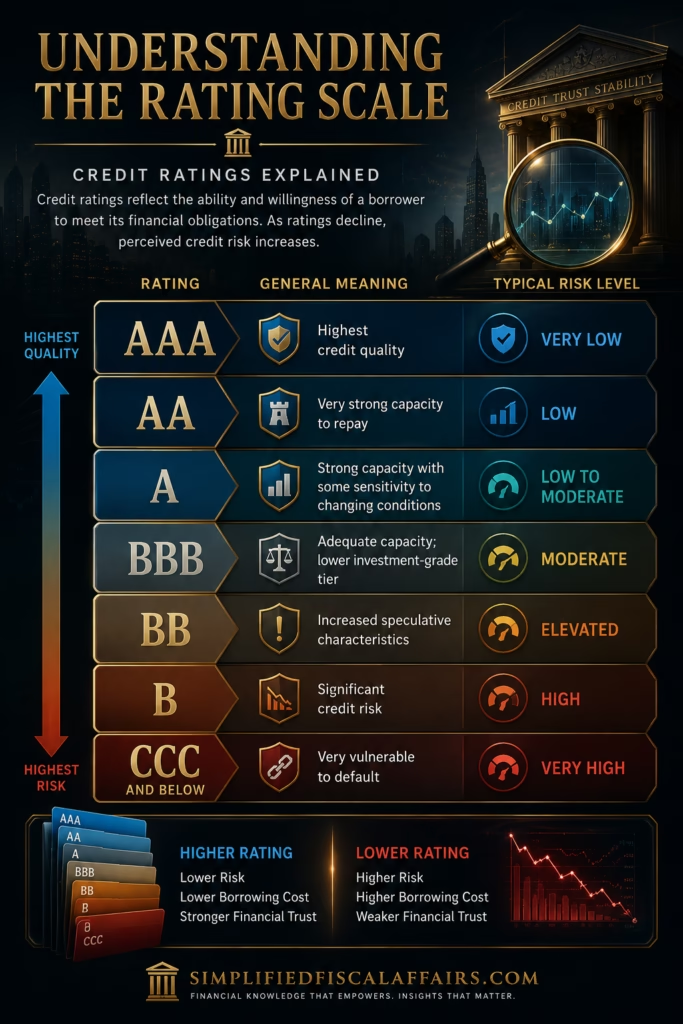
Understanding the Rating Scale
Credit ratings generally range from the highest-quality borrowers to those facing substantial financial uncertainty.
A simplified version looks like this:
| Rating | General Meaning | Typical Risk Level |
|---|---|---|
| AAA | Highest credit quality | Very Low |
| AA | Very strong capacity to repay | Low |
| A | Strong capacity with some sensitivity to changing conditions | Low to Moderate |
| BBB | Adequate capacity; lower investment-grade tier | Moderate |
| BB | Increased speculative characteristics | Elevated |
| B | Significant credit risk | High |
| CCC and below | Very vulnerable to default | Very High |
Although terminology differs slightly among agencies, the overall progression is similar: as ratings decline, perceived credit risk increases.
Investment Grade vs. High-Yield Bonds
One of the most important distinctions in the bond market is between investment-grade and high-yield (often called speculative) bonds.
Investment-Grade Bonds
These bonds are generally issued by borrowers considered to have relatively strong credit quality.
They are widely held by:
- Pension funds.
- Insurance companies.
- Banks.
- Central banks.
- Conservative investment funds.
Because investors perceive lower risk, these bonds typically offer lower yields.

High-Yield Bonds
High-yield bonds are issued by borrowers with weaker credit profiles or greater uncertainty.
To attract investors, these issuers usually offer higher interest rates.
The higher yield compensates investors for accepting greater credit risk.
This illustrates a fundamental principle:
Higher potential return often comes with higher risk.
Why Ratings Affect Borrowing Costs
Imagine two companies each wish to borrow ₹10,000 crore.
Company A
- Strong profitability.
- Stable cash flows.
- Conservative debt levels.
- Excellent repayment history.
Credit Rating:
AAA
Company B
- Declining revenues.
- Heavy existing debt.
- Uncertain earnings.
- Financial restructuring underway.
Credit Rating:
BB
Which company can borrow more cheaply?
Almost certainly Company A.
Because investors perceive it as more reliable, they are generally willing to accept a lower yield.
Company B must usually offer a higher interest rate to compensate for greater uncertainty.
This difference in financing costs can significantly influence long-term profitability and competitiveness.
What Analysts Examine
Credit ratings are based on extensive analysis rather than a single financial ratio.
Analysts may consider:
Financial Strength
- Revenue stability.
- Profitability.
- Cash flow generation.
- Existing debt.
- Liquidity.
Business Profile
- Competitive position.
- Industry characteristics.
- Market share.
- Diversification.
Management and Governance
- Leadership quality.
- Financial discipline.
- Risk management.
- Corporate governance.
Economic Environment
- Industry trends.
- Interest-rate conditions.
- Inflation.
- Regulatory changes.
- Macroeconomic outlook.
For sovereign borrowers, additional considerations include fiscal policy, economic growth, institutional strength, and external debt.

Ratings Can Change
Credit ratings are not permanent.
As financial conditions evolve, agencies may revise their assessments.
A company launching successful new products, reducing debt, and improving profitability could receive a rating upgrade.
Conversely, persistent losses, rising leverage, or deteriorating economic conditions could lead to a downgrade.
These changes often influence bond prices because investors reassess the issuer’s risk.
When Ratings Influence Markets
Imagine a government unexpectedly receives a significant credit downgrade.
Investors may become more cautious.
Some institutional investors whose policies require investment-grade securities may be forced to reduce their holdings.
Demand decreases.
Bond prices may decline.
Yields may rise.
As borrowing becomes more expensive, future government financing costs can increase.
The same mechanism applies to corporations.
Credit ratings therefore affect not only investors but also the real economy.

Ratings Are Helpful—But Not Infallible
Although credit ratings provide valuable information, they are opinions rather than certainties.
History has shown that unexpected economic events, corporate scandals, or financial crises can affect even highly rated borrowers.
Professional investors therefore combine ratings with:
- Financial statement analysis.
- Industry research.
- Macroeconomic analysis.
- Market pricing.
- Scenario testing.
Credit ratings are one important tool—not the only tool.

Institutional Insight
Large institutional investors rarely purchase bonds based solely on yield.
Before considering return, they ask:
- Is the issuer financially resilient?
- Can it continue servicing debt during an economic slowdown?
- How does this bond affect overall portfolio risk?
- Is the additional yield sufficient compensation for the additional credit risk?
This disciplined approach explains why successful bond investing is as much about managing risk as generating income.

Common Beginner Mistakes
Many new investors believe:
“The highest-yielding bond must be the best investment.”
In reality, unusually high yields often signal elevated credit risk.
Another misconception is:
“AAA-rated bonds cannot lose value.”
While they generally have lower default risk, their market prices can still fluctuate due to changes in interest rates and broader market conditions.
Professional Investor’s Checklist
Before purchasing a bond, experienced investors often ask:
✔ What is the issuer’s credit rating?
✔ Is the bond investment grade or high yield?
✔ Has the rating recently changed?
✔ Does the offered yield adequately compensate for the credit risk?
✔ How would a downgrade affect the bond’s market value?
✔ Does this investment fit the portfolio’s overall risk objectives?


Chapter Summary
Credit ratings help investors evaluate one of the most important questions in fixed-income investing: How likely is the borrower to repay?
Although no rating can eliminate uncertainty, standardized assessments provide a common language for comparing issuers across industries and countries.
Higher-rated borrowers generally enjoy lower borrowing costs because investors perceive less risk. Lower-rated borrowers typically pay higher yields to compensate investors for accepting greater uncertainty.
Understanding credit ratings allows investors to move beyond simply chasing higher returns and begin evaluating the balance between risk and reward—a principle that underpins all successful investing.
← Previous Chapter Beyond the Coupon: How Professional Investors Measure the Real Ultimate Return of a Bond – VIII
Next Chapter →The Yield Curve Explained – X
Coming Next
Chapter 10 – The Yield Curve Explained: Why Economists Call It the Crystal Ball of the Economy
In the next chapter, you’ll discover:
- What the yield curve really is.
- Why short-term and long-term bond yields differ.
- What a normal, flat, and inverted yield curve means.
- Why central banks, economists, and institutional investors monitor the yield curve every day.
- How the yield curve has historically signaled major economic slowdowns before they occurred.
By the end of the next chapter, you’ll understand why a simple graph of government bond yields is considered one of the most closely watched indicators in global finance.