

The Hidden Mathematics of Bond Yield and Total Return
Current Yield, Yield to Maturity, and Why Professional Investors Focus on Yield Instead of Coupon Rate

“The coupon tells you what the bond promised years ago. The yield tells you what the bond is worth today.”
Introduction: The Number That Really Matters
Imagine two investors meeting at an investment conference.
The first proudly says,
“I own a bond that pays an 8% coupon.”
The second smiles and asks,
“What’s the yield?”
The first investor hesitates.
Why would someone ignore the coupon—the very interest rate printed on the bond—and ask about yield instead?
The answer reveals one of the biggest differences between beginner and professional bond investors.
Beginners often focus on the coupon rate because it is easy to understand.
Professionals focus on yield because it reflects the bond’s value under current market conditions.
The coupon tells the story of the past.
The yield tells the story of the present.

Coupon Rate vs Yield
Many people mistakenly believe these two terms mean the same thing.
They do not.
The coupon rate is fixed when the bond is issued.
If a company issues a ₹100,000 bond with a 6% coupon, the annual interest payment remains ₹6,000 regardless of how market prices change.
Yield, however, changes whenever the bond’s market price changes.
This distinction is crucial because bonds trade every day in secondary markets.
Professional investors are buying bonds at today’s market price—not necessarily at the original issue price.
A Simple Example
Suppose a government issues a bond with:
- Face Value: ₹100,000
- Coupon Rate: 8%
- Annual Coupon Payment: ₹8,000
When the bond is first issued, it is sold for ₹100,000.
At that moment:
Coupon Rate = Yield = 8%
Everything appears simple.
But markets rarely remain unchanged.
When Market Prices Change
Imagine interest rates increase across the economy.
Your bond becomes less attractive because newly issued bonds now pay 10%.
To attract buyers, your bond’s market price falls to ₹90,000.
Notice something important.
The government still pays:
₹8,000 every year.
Nothing about the coupon changed.
Only the market price changed.
Because a new investor now pays only ₹90,000 to receive ₹8,000 annually, the return relative to the purchase price becomes higher.
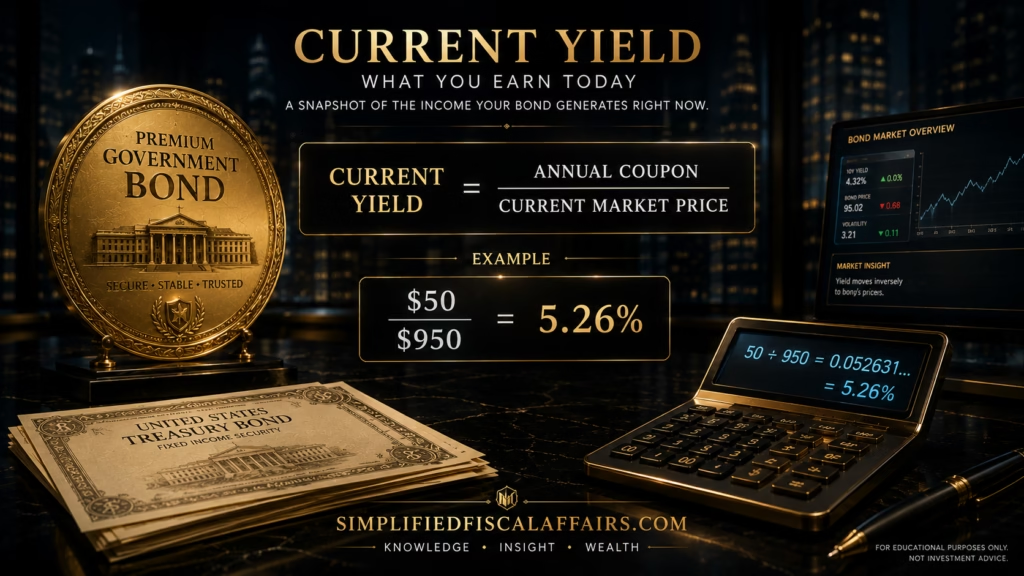
This new return is called current yield.

Current Yield
Current yield measures the annual coupon income relative to the bond’s current market price.
Instead of looking at the original issue price, it asks a practical question:
“If I buy this bond today, what percentage of my purchase price will I receive as annual interest?”
Example:
Annual Coupon = ₹8,000
Current Market Price = ₹90,000
Current Yield =
₹8,000 ÷ ₹90,000
≈ 8.89%
The bond still pays exactly ₹8,000.
But because the investor paid less for it, the income represents a larger percentage return.
Explore Present Value and Discounting
Understanding why bond prices and yields move together starts with the concept of present value.
Why Current Yield Isn’t the Complete Picture
Suppose you buy the same bond for ₹90,000.
At maturity, the issuer will repay:
₹100,000
That means you receive:
- Annual coupon payments.
- An additional ₹10,000 capital gain at maturity.
Current yield considers only the coupon income.
It completely ignores the gain resulting from buying below face value.
Professional investors therefore need a more comprehensive measure.
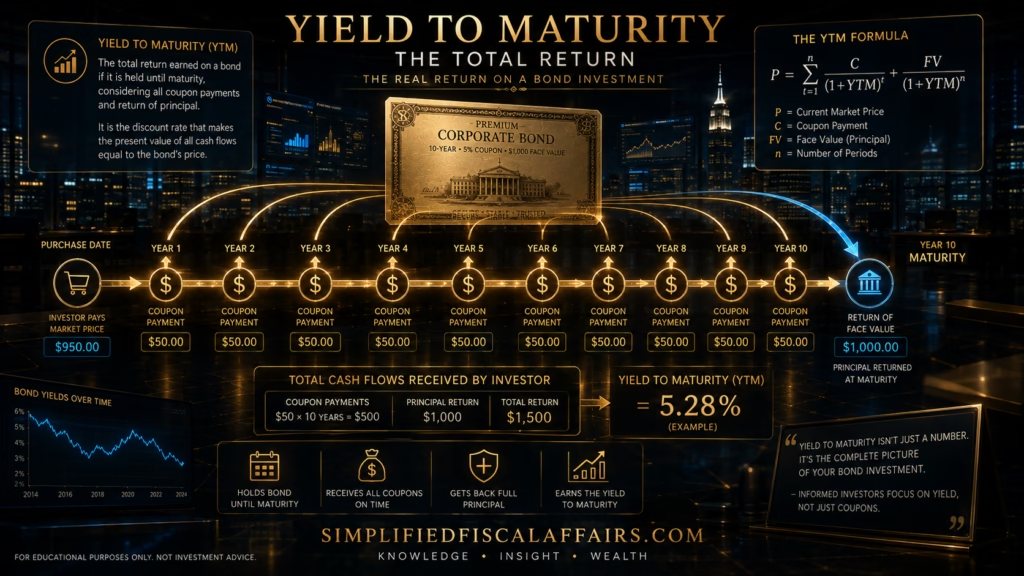
Yield to Maturity (YTM)
Yield to Maturity is often considered the most important measure in bond investing.
Instead of examining only annual coupon payments, it estimates the total annualized return an investor would earn if:
- The bond is purchased today.
- All coupon payments are received as scheduled.
- The bond is held until maturity.
- The issuer does not default.
YTM includes:
- Coupon income.
- Capital gain or loss between purchase price and face value.
- The remaining life of the bond.
Because it captures nearly every significant cash flow, YTM provides a more complete picture of expected return than current yield alone.
Why Professionals Prefer Yield to Maturity
Imagine two bonds.
Bond A
Price:
₹100,000
Coupon:
6%
Maturity:
2 Years
Bond B
Price:
₹90,000
Coupon:
6%
Maturity:
2 Years
Both bonds pay exactly the same annual coupon.
However, Bond B also offers a ₹10,000 gain when it matures because it was purchased below face value.
Even though the coupons are identical, the expected overall return differs.
Yield to Maturity captures this difference.
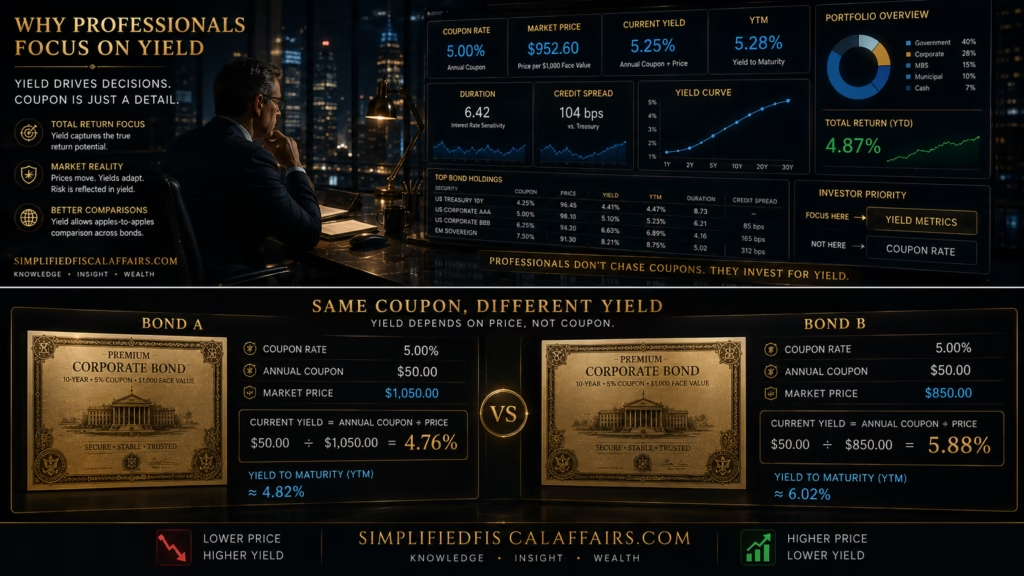
For that reason, institutional investors almost always compare bonds using YTM rather than coupon rates.

Premium Bonds and Discount Bonds
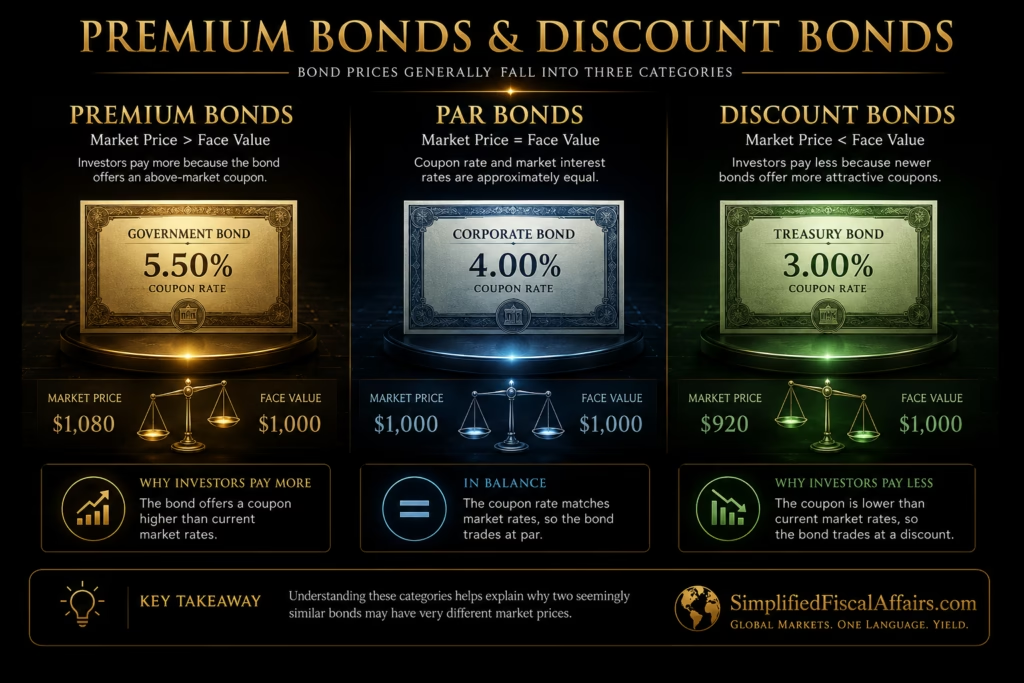
Bond prices generally fall into three categories.
Premium Bonds
Market Price > Face Value
Investors pay more because the bond offers an above-market coupon.
Par Bonds
Market Price = Face Value
Coupon rate and market interest rates are approximately equal.
Discount Bonds
Market Price < Face Value
Investors pay less because newer bonds offer more attractive coupons.
Understanding these categories helps explain why two seemingly similar bonds may offer different yields.
Why Yield Changes Every Day
Unlike the coupon, yield is dynamic.
It changes as market prices fluctuate.
Bond prices respond to factors such as:
- Central bank decisions.
- Inflation expectations.
- Economic growth.
- Credit quality.
- Market demand.
- Global events.
Because prices move continuously, yields also change continuously.
This is why financial news outlets report government bond yields every day rather than repeatedly announcing coupon rates established years earlier.
Yield Is the Language of the Bond Market
Professional portfolio managers rarely begin discussions by asking:
“What coupon does this bond pay?”
Instead, they ask questions such as:
- What is the current yield?
- What is the Yield to Maturity (YTM)?
- How does the yield compare with similar bonds?
- Does the yield adequately compensate for inflation?
- Is the yield attractive relative to the bond’s credit risk?
These questions help determine whether a bond is fairly priced or represents a compelling investment opportunity.

Institutional Insight
Imagine managing a pension fund worth ₹50,000 crore.
Even a small difference in yield can significantly affect long-term returns.
An additional 0.50% annual yield on a very large portfolio may translate into substantial additional income over time.
For this reason, institutional investors devote considerable effort to analyzing yield rather than relying solely on coupon rates.
Yield is not just a statistic—it is a key input in portfolio construction, risk management, and long-term financial planning.
Common Beginner Mistakes
Many first-time investors assume:
“A higher coupon automatically means a better investment.”
Not necessarily.
A bond with a lower coupon but purchased at a deep discount may offer a higher overall yield than a higher-coupon bond trading at a premium.
Another common misconception is:
“Yield and coupon always move together.”
In reality, coupon remains fixed after issuance, while yield changes whenever market prices change.
Understanding this distinction helps investors interpret bond quotations more accurately.

Key Takeaways
The coupon rate tells you how much interest the bond promises to pay based on its face value.
Current yield tells you how much annual income you receive relative to the price you pay today.
Yield to Maturity goes further by considering:
- Coupon payments.
- Purchase price.
- Face value.
- Remaining time until maturity.
Because it reflects the bond’s expected total return under specified assumptions, Yield to Maturity has become one of the most widely used measures in fixed-income investing.
Mastering yield analysis is an essential step toward understanding professional bond investing.
Chapter Summary
Yield is the heartbeat of the bond market. While the coupon rate remains fixed from the day a bond is issued, yield adjusts continuously to reflect changing market prices and investor expectations.
Professional investors focus on yield because it provides a clearer measure of value than the coupon alone. Whether evaluating government debt, corporate bonds, or international fixed-income portfolios, yield helps answer the most important investment question:
“Given today’s market price, what return am I actually earning?”
Understanding this concept prepares us for the next major milestone in bond investing.
← Previous Chapter The Invisible Force Moving Bond Prices: When Rates Move, Trillions Follow – VII
Next Chapter →Bond Ratings Explained – IX
Coming Next
Chapter 9 – Bond Ratings Explained: How Credit Rating Agencies Measure Risk and Why AAA Is Different from Junk Bonds
In the next chapter, we’ll examine how investors assess the likelihood that a borrower will repay its debt. You’ll learn how credit ratings influence bond prices, borrowing costs, institutional investment decisions, and why two bonds with similar coupons can trade at dramatically different yields simply because one borrower is considered more trustworthy than the other.

Disclaimer
This article is published solely for educational, informational, and public awareness purposes. Any companies, organizations, financial institutions, individuals, financial data or scenarios mentioned are used for explanatory or illustrative purposes unless explicitly identified as publicly documented cases. Documentary-style narratives, hypothetical examples, and reconstructed investigative scenarios are intended to help readers understand forensic auditing concepts and should not be interpreted as factual accounts of any specific ongoing investigation.
The information presented does not constitute legal, accounting, auditing, financial, investment, or professional advice. While every effort has been made to ensure accuracy, readers should consult qualified legal, accounting, forensic, or financial professionals before making decisions based on the information contained in this article.
SimplifiedFiscalAffairs.com does not make any allegations against any person, company, or institution, nor does it endorse or condemn any entity referenced. References to publicly known corporate frauds or legal cases are based on information available in the public domain and are included solely for educational analysis.
The publisher and author disclaim any liability for actions taken based on the contents of this article.