

What is Stock Exchange?
- The stock market plays a very important role in the growth and development of the economy. It is an important component of the capital market. The stock market is a place where corporate listed securities are purchased and sold.
- The stock market is an organised and regulated market, only securities that are listed within the stock exchange can be traded.
- Stock exchange is also known as a secondary market, stock market or share bazar.
- It is an organized market for the purchase and sale of securities of joint
- stock companies, government and semi-govt. bodies. It is the centre where shares,
- debentures and govt. securities are bought and sold.
- The term security is composed of equity shares, preference shares, debentures, government securities and bonds.
- Mutual funds also play a crucial role in the growth and development of the stock market. Mutual fund companies have a pool of funds which they invest in the stock market in a certain proportion, by issuing the units of mutual fund at a certain NAV ( Net Asset Value). The NAV fluctuates as per the market conditions.
- The stock exchange works as an intermediary between the investors and companies. The Securities And Exchange Board of India (SEBI) is the regulator of the capital markets in India.
- Stock exchange is also known as a pulse of economy or economic mirror as it reflects the economic conditions prevailing in a country.
- Brokers play an integral part in the trading system of the stock market, as all orders are placed through them.
According to The Securities Contracts Regulation Act 1956, the term stock exchange is defined as, “An association, organisation or body of individuals, whether incorporated or not, established for the purpose of assisting, regulating and controlling of business in buying, selling and dealing in securities”.
Husband and Dockerary have defined stock exchange as: “Stock exchanges are privately organised market which are used to facilitate trading in securities”.
According to Pyle, “Security exchanges are market places where securities that have been listed thereon may be bought and sold for either investment or speculation”.
The Stock Exchange is the ultimate economic barometer as it directly reflects the current economic financial position and plays an integral role as it acts as an important strategic financial tool to predict the future financial estimates and the likely trend of the economy.

Characteristics:
- Securities Market: The stock market is a place where various financial securities are bought and sold.
- Stringent Rules: All the listed companies have to strictly comply to SEBI guidelines and the rules and regulations laid down by the stock exchange.
- Members Only: Securities traded on the stock markets can only be executed by the members of the exchange on their own or through authorised brokers.
- Convenient: Now-a-days all trading activities are done electronically on the stock exchange.
“Every day, billions of dollars change hands in financial markets. Most investors rely on public information. But what happens when someone knows the future before everyone else?”
Behind some of the largest stock market gains and losses lies a powerful advantage: information.
In financial markets, information is currency.
The faster investors receive it, the greater their potential advantage.
But when confidential corporate information is used for personal profit before it becomes public, the line between investing and illegal market manipulation begins to blur.
This is the world of insider trading.
A world where a single phone call, leaked email, or private meeting can generate millions in profits while undermining the fairness of financial markets.
What Does The Stock Market Do?
- Channel For Savings: Stock markets are designed in a way to protect and promote the interests of the investors. Stock markets are organised and regulated. This motivates investors to invest in the securities market.
- Corpus Creation: Investment in the securities market for a significant timeline renders attractive returns to the investors and leads to capital appreciation. The corporate sector raises finance through the stock exchange by issuing various financial securities like equity shares, preference shares, debentures, bonds, etc.
- Easy Raising of Capital: Any company’s primary objective and reason behind listing on the stock exchange is raising capital from the common man. Companies constantly and consistently need funds for expansion and diversification of their core business operational activities, undertaking various higly capital intensive projects which needs a significant amount of capex (capital expenditure). The funds collected can be used to repay debts, establish new plants or offices, acquire smaller companies, boost operations, hire more workforce, and so on. Since the pool of investors is extremely large, a company can spread out any associated risk thinly.
- Optimum Utilisation: The idle funds in the hands of individuals are not effectively used in the economy. Stock exchange facilities effective allocation of funds to productive and profitable channels.
- Economic Indicator: The stock market is an effective Indicator and reflector of the economy. Various forecasts and estimates can be drawn upon by analysing the market conditions prevalent. The fluctuations in the share prices indicates the boom or recession cycle of the economy. It is the pulse of the economy or economic mirror as it exactly reflects the prevailing economy.
- Liquidity of Cash: The stock market facilities liquidity of cash, the money invested in the stock market can be converted into cash at anytime. Long term investments can be made unhesitantly, as it can be liquidated quickly.
- Economic Development: Stock markets covert savings into investments. Business entities make use of investor funds to take up production or commercial activities thereby, leading to economic development. It transfers real economic resources from lenders to borrowers, which inturn are used for productive activities.
- Fair Valuation: The prices of these securities are derived from the mechanism of effective demand and supply forces. The investors supply the funds and the business entities utilize. The securities of profitable and fundamentally strong companies are valued higher due to strong demand forces. Fair Valuation helps the creditors to estimate the credit worthiness of the organisation.
- Investor Oriented: Stock markets are designed in the way to protect and promote the interests of the investors. Companies have to strictly comply to the rules and regulations made by the SEBI Act and the stock exchange. Stock exchange allows listing only after verifying the soundness of the company. Companies listed, have to operate within the framework provided by the stock exchange and the SEBI (The Securities and Exchange Board of India) which ensures atmost safety of the investors’ funds.
- Intermediary: The stock markets act as a link between the company and the investors. It routes finance from savers to entrepreneurial borrowers.
- Collaborates with: The stock markets associate with various intermediaries like brokers, underwriters, merchant bankers, collection bankers. They play an important role in the smooth functioning of the entire system.
- Investors: The stock markets have a wide range of investors. It consists of both the individual and the institutional type (Mutual Funds) of investors.
What Is Insider Trading?
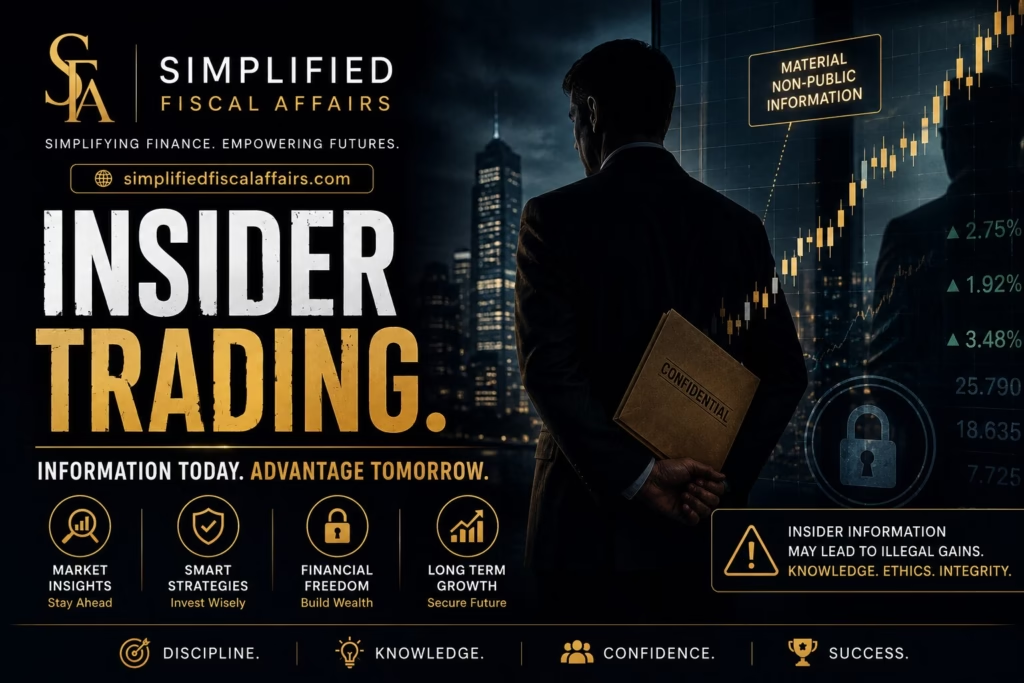
Insider trading occurs when a person buys or sells securities based on material, non-public information.
To understand insider trading, three concepts are critical:
Material Information
Information is considered material if a reasonable investor would consider it important when making an investment decision.
Examples include:
- Earnings surprises
- Major acquisitions
- Bankruptcy risks
- Regulatory approvals
- Product launches
- Significant lawsuits
- Leadership changes
Non-Public Information
The information has not yet been released to the public.
Only a limited group of individuals possess knowledge of the event.
Trading Activity
An individual uses this confidential information to:
- Buy shares
- Sell shares
- Purchase options
- Recommend trades to others
The profit arises because the market has not yet adjusted to the information.
Why Insider Trading Is So Powerful
Financial markets are designed around equal access to information.
Prices move because investors constantly evaluate new information.
When one individual possesses information that others do not, the playing field becomes uneven.
Imagine knowing:
- A company will announce record profits tomorrow.
- A major merger will be announced next week.
- A regulatory approval is imminent.
- A product has unexpectedly failed.
The ability to act before the market reacts creates enormous financial advantages.
The Information Advantage
Consider a hypothetical example.
A pharmaceutical company is awaiting approval for a breakthrough drug.
The stock trades at ₹1,000 per share.
Only a handful of executives know approval has already been secured.
An insider purchases shares before the announcement.
The next day the approval becomes public.
The stock jumps 40%.
The insider profits immediately.
Meanwhile ordinary investors only learn the news after prices have already adjusted.
This information imbalance is precisely what insider trading laws seek to prevent.
How Insider Trading Typically Happens
Most insider trading does not resemble dramatic movie scenes.
It often begins with ordinary professional relationships.
Corporate Executives
Senior management frequently has access to:
- Financial results
- Strategic plans
- Acquisition discussions
- Capital raising activities
Because of this access, executives face strict trading restrictions.
Employees
Employees working in:
- Finance departments
- Investor relations
- Legal teams
- Research divisions
may encounter sensitive information before public release.
Professional Advisors
Outside professionals often gain access to confidential data.
Examples include:
- Investment bankers
- Auditors
- Lawyers
- Consultants
- Accountants
Large transactions frequently involve dozens of advisers, increasing the risk of information leaks.
The Tipping Process
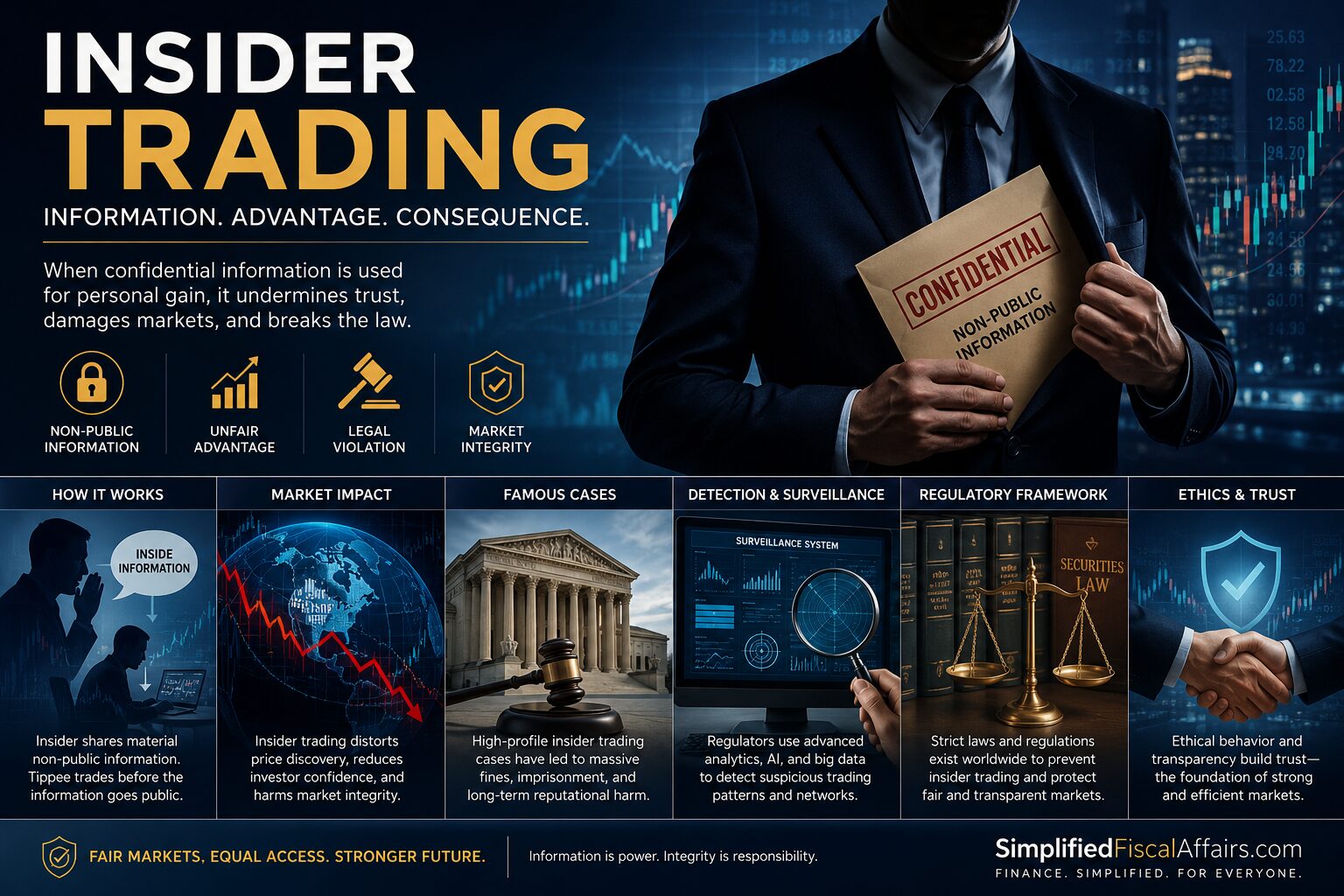
One of the most common forms of insider trading involves “tipping.”
An insider does not trade personally.
Instead, they share information with another person.
Examples include:
- Friends
- Family members
- Business associates
- Professional contacts
The recipient then executes the trade.
This creates distance between the source of information and the transaction itself.
However, regulators increasingly use sophisticated surveillance systems to identify such patterns.
The Merger Scenario
Corporate acquisitions are among the most sensitive events in finance.
Imagine Company A plans to acquire Company B.
Before the announcement:
- Lawyers review contracts.
- Bankers arrange financing.
- Consultants perform due diligence.
- Executives negotiate terms.
Dozens or even hundreds of people may know the deal is happening.
If someone purchases shares before the public announcement, investigators may examine whether confidential information influenced the trade.
Historically, many major insider trading cases have involved merger activity because acquisition announcements often trigger significant stock price movements.
Why Insider Trading Is Difficult To Detect
Unlike robbery or fraud, insider trading leaves no obvious crime scene.
Investigators must reconstruct:
- Who knew the information
- When they learned it
- Who they communicated with
- When trades occurred
Modern investigations combine:
- Trading records
- Phone records
- Email communications
- Messaging applications
- Banking activity
Regulators look for patterns rather than isolated transactions.
The Role of Market Surveillance
Financial regulators use sophisticated technology to monitor markets.
Surveillance systems analyze:
- Unusual trading volume
- Large option purchases
- Suspicious timing
- Trading before major announcements
Algorithms can identify statistically unusual activity that warrants further investigation.
In today’s markets, unusual trading rarely goes unnoticed.
Famous Insider Trading Cases
Throughout history, insider trading scandals have involved:
- Corporate executives
- Hedge fund managers
- Investment bankers
- Lawyers
- Consultants
These cases often reveal how valuable confidential information can become when converted into market profits.
Many investigations have demonstrated that even highly sophisticated individuals leave traces through communication patterns and trading records.
The Ethical Problem
Beyond legality, insider trading raises fundamental ethical concerns.
Financial markets function because participants trust that prices reflect publicly available information.
If investors believe markets are rigged in favor of insiders:
- Confidence declines
- Participation decreases
- Capital allocation becomes less efficient
Market integrity depends on fairness.
Insider trading threatens that foundation.
Why Some People Take the Risk
The motivations are often surprisingly simple.
Greed
The possibility of quick profits can be highly attractive.
Pressure
Financial stress may encourage poor decisions.
Overconfidence
Some insiders believe they will never be detected.
Rationalization
Individuals may convince themselves that:
- Nobody gets hurt.
- The information will become public soon anyway.
These psychological justifications frequently appear in white-collar crime investigations.
The Regulatory Response
Governments around the world impose strict rules to protect market integrity.
Common safeguards include:
- Trading blackout periods
- Disclosure requirements
- Compliance monitoring
- Mandatory reporting
- Surveillance systems
Public companies often prohibit employees from trading before earnings announcements or major corporate events.
The goal is to maintain investor confidence and reduce opportunities for abuse.
Lessons for Investors
Insider trading provides an important lesson about investing.
Markets are information-driven systems.
Understanding how information flows can help investors appreciate:
- Market efficiency
- Corporate governance
- Regulatory oversight
- Risk management
Most importantly, it highlights why transparency remains one of the most valuable assets in finance.
INSIDER TRADING: THE COMPLETE PREMIUM FINANCE GUIDE FROM BASICS TO ADVANCED
How Information Becomes Money, Power, and Risk in Financial Markets
Understanding insider trading is essential because it reveals one of the most fundamental principles of modern financial markets:
When privileged information is exploited unfairly, confidence deteriorates, capital allocation becomes distorted, and market integrity suffers.
This article provides a comprehensive institutional-level examination of insider trading—from foundational concepts to advanced legal frameworks, enforcement mechanisms, historical scandals, hedge fund investigations, behavioral dynamics, and the future of insider surveillance in the age of artificial intelligence.
Part I: Foundations of Insider Trading
What Is Insider Trading?
At its simplest level:
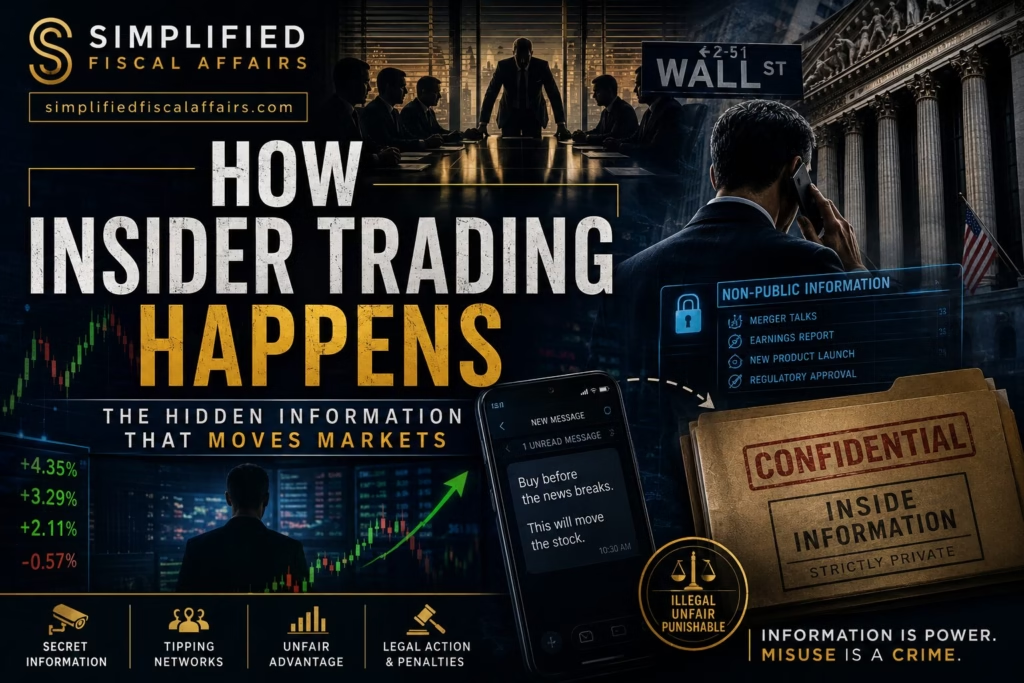
Insider trading occurs when securities are bought or sold using material non-public information (MNPI).
The concept revolves around three critical elements:
1. Information
The trader possesses information unavailable to the investing public.
2. Materiality
The information would likely influence an investor’s decision.
3. Non-Public Nature
The information has not yet been disseminated broadly to the market.
If all three conditions exist, trading may violate securities laws.
Understanding Material Information
Information is considered material if a reasonable investor would view it as important.
Examples include:
Corporate Events
- Earnings surprises
- Dividend announcements
- Mergers and acquisitions
- Major contracts
- Bankruptcies
Strategic Developments
- New product launches
- Patent approvals
- Regulatory approvals
Financial Information
- Revenue changes
- Cash flow deterioration
- Credit downgrades
Management Information
- CEO resignation
- Fraud discovery
- Internal investigations
Materiality is judged based on:
- Magnitude
- Probability
- Expected market impact
Public vs. Non-Public Information
Not all valuable information is illegal.
Institutional investors spend billions collecting:
- Industry research
- Alternative data
- Consumer trends
- Supply chain intelligence
- Satellite imagery
This is legal because information is obtained through legitimate research.
The distinction is critical:
| Legal Information Edge | Illegal Information Edge |
|---|---|
| Superior analysis | Confidential information |
| Public sources | Non-public sources |
| Independent research | Fiduciary breach |
| Alternative datasets | Corporate secrets |
| Expert interpretation | Insider leaks |
This distinction forms the foundation of securities regulation worldwide.
Why Insider Trading Matters
Insider trading creates asymmetrical information advantages.
Imagine:
Investor A possesses confidential knowledge that Company XYZ will be acquired at a 50% premium tomorrow.
Investor B has no such information.
If Investor A purchases shares before the announcement:
- Gains become virtually guaranteed.
- Risk becomes artificially reduced.
- Market fairness deteriorates.
This undermines confidence in financial markets.
Part II: Economic Theory Behind Insider Trading
Information Asymmetry
Economist George Akerlof demonstrated how information imbalances can damage markets.
His famous “Market for Lemons” theory showed that unequal information can:
- Reduce trust
- Lower participation
- Increase inefficiency
Financial markets face the same challenge.
Efficient Market Hypothesis
The Efficient Market Hypothesis suggests prices rapidly incorporate available information.
Insider trading challenges this theory because:
- Certain participants receive information first.
- Prices may not fully reflect reality.
- Information diffusion becomes unequal.
The result is delayed price discovery.
Market Integrity
Healthy markets require:
- Transparency
- Fairness
- Trust
- Disclosure
Insider trading threatens all four pillars.
This is why regulators aggressively pursue violations.
Part III: Legal Insider Trading vs Illegal Insider Trading
One of the most misunderstood aspects of finance is that not all insider trading is illegal.
Legal Insider Trading
Corporate insiders may legally buy or sell company shares.
Examples include:
- CEOs
- CFOs
- Directors
- Major shareholders
Legal insider transactions require:
- Regulatory disclosure
- Compliance procedures
- Trading windows
Such transactions are publicly reported.
Investors often monitor these filings because they may reveal management confidence.
Illegal Insider Trading
Illegal insider trading occurs when someone trades based on material non-public information.
Examples:
- Buying stock before an acquisition announcement
- Selling shares before earnings disappointment
- Trading before fraud disclosure
These actions violate securities regulations.

Part IV: Types of Insider Trading Schemes
Classical Insider Trading
The traditional model.
Example:
A CEO learns earnings will double.
Before public release:
- CEO buys shares.
- Earnings announced.
- Stock rises dramatically.
Illegal profit results.
Tipper-Tippee Model
A common enforcement target.
Tipper
Person with confidential information.
Tippee
Person receiving information.
Example:
Executive tells friend:
“Our company is about to be acquired.”
Friend purchases stock.
Both parties may be liable.
Misappropriation Theory
Information is stolen from its rightful owner.
Example:
A law firm employee learns about a merger.
The employee trades before announcement.
Even though not employed by the company involved, liability may still exist.
Insider Networks
Complex information-sharing systems involving:
- Consultants
- Bankers
- Lawyers
- Analysts
- Executives
These networks often become major enforcement targets.
Part V: Corporate Events Most Vulnerable to Insider Trading
Mergers and Acquisitions
M&A transactions create enormous opportunities.
Information leaks may reveal:
- Purchase price
- Deal structure
- Approval likelihood
Stocks often move significantly after announcements.
Thus M&A remains one of the largest insider trading risk areas.
Earnings Announcements
Quarterly earnings provide powerful information advantages.
Examples:
- Revenue surprises
- Profit misses
- Guidance revisions
Trading before disclosure can generate substantial profits.
Drug Approvals
In biotechnology:
- FDA decisions
- Clinical trial results
- Safety findings
can create dramatic price swings.
Bankruptcy Events
Knowledge of:
- Insolvency
- Debt restructuring
- Liquidity crises
can generate enormous informational advantages.
Part VI: Hedge Funds and Insider Trading Risk
Why Hedge Funds Are Vulnerable
Hedge funds seek information advantages.
Competitive pressure creates incentives to obtain:
- Earlier insights
- Better forecasts
- Superior intelligence
The challenge is remaining within legal boundaries.
Expert Networks
Expert networks connect investors with industry specialists.
Examples:
- Former executives
- Engineers
- Physicians
- Supply-chain experts
When managed properly:
- Legal
- Valuable
When MNPI is exchanged:
- Significant regulatory risk emerges.
Mosaic Theory
One of the most important concepts in institutional investing.
The theory allows investors to combine:
- Public information
- Industry observations
- Market intelligence
to generate unique insights.
This is entirely legal.
The key distinction:
No material non-public information may be used.
Part VII: How Regulators Detect Insider Trading
Surveillance Technology
Modern regulators use advanced analytics.
Monitoring systems analyze:
- Trading timing
- Profitability
- Network relationships
- Communication records
Unusual patterns trigger investigations.
Statistical Analysis
Regulators examine:
Abnormal Returns
Unexpected profits before announcements.
Volume Spikes
Unusual trading activity.
Option Activity
Suspicious call or put purchases.
Relationship Mapping
Connections among participants.
Artificial Intelligence
Modern enforcement increasingly uses AI to identify:
- Behavioral anomalies
- Communication clusters
- Trading networks
- Suspicious correlations
Detection capabilities continue improving rapidly.
Part VIII: Insider Trading and Behavioral Finance
Greed
Many cases originate from:
- Desire for easy profits
- Overconfidence
- Competitive pressure
Rationalization
Individuals often justify misconduct:
- “Everyone does it.”
- “Nobody gets hurt.”
- “It’s only one trade.”
These psychological biases appear repeatedly in enforcement cases.
Overconfidence Bias
Successful traders may begin believing:
- They are smarter than regulators.
- Detection is unlikely.
- Their system is foolproof.
History repeatedly proves otherwise.
Part IX: Global Regulation of Insider Trading
United States
Primary regulators include:
- U.S. Securities and Exchange Commission
- Department of Justice
Penalties include:
- Fines
- Disgorgement
- Trading bans
- Imprisonment
United Kingdom
Enforcement is led by the Financial Conduct Authority.
European Union
The EU employs comprehensive market abuse regulations.
Focus areas include:
- Market manipulation
- Insider dealing
- Information disclosure
India
In India, insider trading is regulated by the Securities and Exchange Board of India.
SEBI regulations cover:
- Designated persons
- Trading windows
- Disclosure obligations
- Compliance systems
India has significantly strengthened enforcement in recent years.
Part X: Advanced Quantitative Detection Techniques
Modern regulators increasingly use:
Event Studies
Comparing stock performance around major announcements.
Machine Learning Models
Identifying suspicious patterns among millions of trades.
Network Analytics
Mapping relationships between:
- Traders
- Executives
- Brokers
- Advisors
Communication Surveillance
Reviewing:
- Emails
- Messaging applications
- Phone records
These methods have dramatically increased enforcement effectiveness.

Part XI: Insider Trading in the AI Era
Artificial intelligence is changing both sides of the equation.
Regulators
Can process:
- Billions of trades
- Communication metadata
- Social networks
Traders
Can analyze:
- Alternative datasets
- Corporate disclosures
- Market sentiment
The future battlefield increasingly revolves around information analytics rather than traditional surveillance alone.
Part XII: Ethical Dimensions of Insider Trading
The debate remains active.
Critics Argue
Insider trading:
- Damages fairness
- Hurts confidence
- Distorts prices
Some Economists Argue
Information should flow into prices rapidly regardless of source.
However, most modern markets reject unrestricted insider trading because maintaining trust is viewed as essential for capital formation.
Lessons from Major Insider Trading Scandals
Recurring themes include:
- Information leaks always expand.
- Networks become detectable.
- Electronic records create evidence.
- Profits attract scrutiny.
- Overconfidence accelerates failure.
- Surveillance technology continually improves.
The vast majority of major insider-trading schemes eventually collapse under investigation.
The Future of Insider Trading Enforcement
The next decade will likely feature:
- AI-driven surveillance
- Real-time market monitoring
- Blockchain analytics
- Cross-border cooperation
- Advanced behavioral detection
- Predictive compliance systems
Regulators may eventually identify suspicious trading patterns within minutes rather than months.
Conclusion
- The modern financial system depends on trust.
- Investors trust that prices reflect publicly available information.
- Companies trust that capital markets are fair.
- Regulators work to preserve confidence in the system.
- Insider trading challenges that trust by giving a select few access to opportunities unavailable to everyone else.
- And when trust disappears, markets become weaker, less efficient, and less credible.
- Insider trading represents far more than a securities-law violation. It is a challenge to the very foundations of modern capital markets.
- At its core, the issue concerns who has access to information, when they receive it, and whether that advantage can be converted into financial gain before the broader market becomes aware.
- From corporate boardrooms and investment banks to hedge funds and regulatory agencies, insider trading remains one of the most important subjects in finance because it touches the central pillars of market integrity: transparency, fairness, trust, and efficient capital allocation.
- As markets become increasingly digitized and artificial intelligence transforms surveillance capabilities, the future of insider trading enforcement will likely become more sophisticated than ever before. Yet the fundamental principle will remain unchanged:
- Financial markets function best when success is driven by superior analysis, research, and judgment—not by unfair access to secrets.
“In financial markets, information creates value. But when information becomes a secret advantage, the line between intelligence and unfairness becomes dangerously thin.”
“The most valuable asset in finance isn’t money. It’s trust. And once trust disappears, even the largest institutions can fall.”
Disclaimer
The information provided in this article is for educational, informational, and awareness purposes only. It does not constitute financial, investment, legal, tax, accounting, or professional advice. Any references to companies, financial institutions, securities, regulators, market events, or individuals are made solely for educational and analytical purposes and should not be interpreted as recommendations or endorsements. Readers should conduct their own research and consult qualified professionals before making any financial or investment decisions. SimplifiedFiscalAffairs.com and its authors are not responsible for any losses or damages arising from the use of this information.