


How Corporate Bonds Fuel Business Growth Without Giving Away Ownership
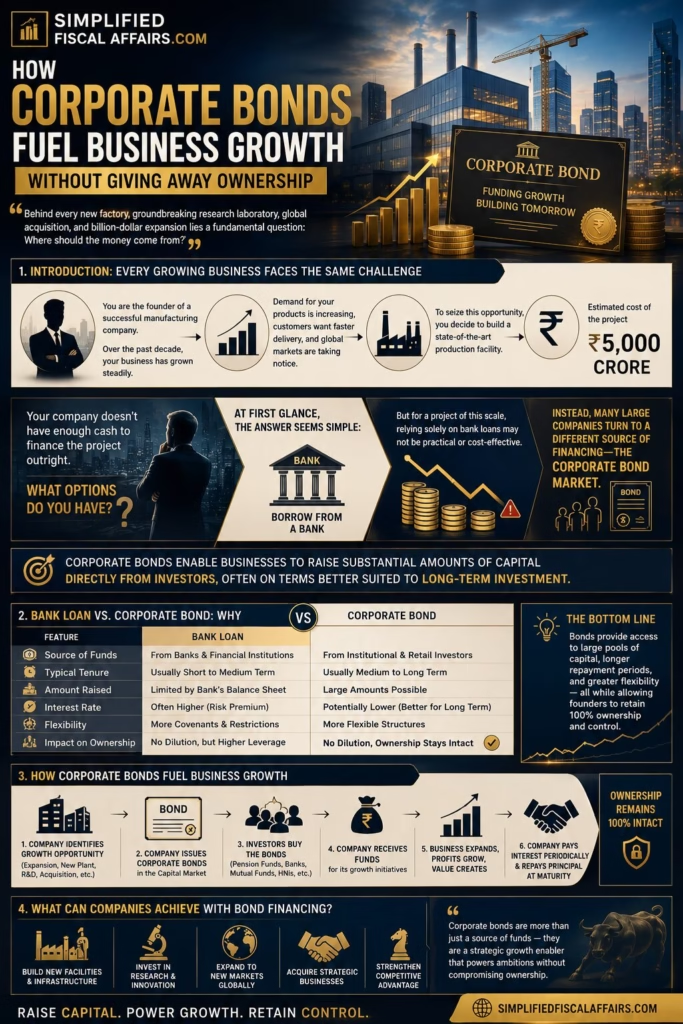
Bonds provide access to large pools of capital, longer repayment durations and greater flexibility, all while allowing founders to retain 100% ownership and control.
Corporate bonds are more than just a source of funds- they are a strategic growth enabler that powers ambitions without diluting ownership.
“Behind every new factory, groundbreaking research laboratory, global acquisition, and billion-dollar expansion lies a fundamental question: Where should the money come from?”
Introduction: Every Growing Business Faces the Same Challenge
Imagine you are the founder of a successful manufacturing company.
Over the past decade, your business has grown steadily. Demand for your products is increasing, customers are asking for faster delivery, and international markets are beginning to take notice.
To seize this opportunity, you decide to build a state-of-the-art production facility.
The estimated cost is ₹5,000 crore.
Your company doesn’t have enough cash to finance the project outright.
What options do you have?
At first glance, the answer seems simple: borrow from a bank.
But for a project of this scale, relying solely on bank loans may not be practical or cost-effective. Instead, many large companies turn to a different source of financing—the corporate bond market.
Corporate bonds enable businesses to raise substantial amounts of capital directly from investors, often on terms better suited to long-term investment.
The Three Main Ways Companies Raise Capital
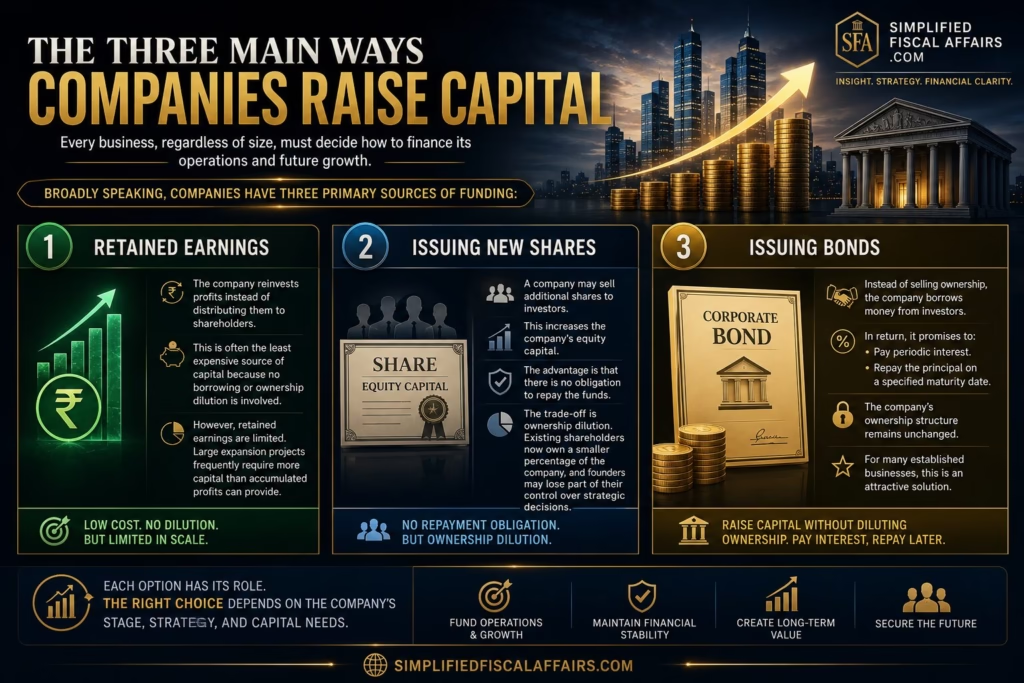
Every business, regardless of size, must decide how to finance its operations and future growth.
Broadly speaking, companies have three primary sources of funding:
1. Retained Earnings
The company reinvests profits instead of distributing them to shareholders.
This is often the least expensive source of capital because no borrowing or ownership dilution is involved.
However, retained earnings are limited. Large expansion projects frequently require more capital than accumulated profits can provide.
2. Issuing New Shares
A company may sell additional shares to investors.
This increases the company’s equity capital.
The advantage is that there is no obligation to repay the funds.
The trade-off is ownership dilution.
Existing shareholders now own a smaller percentage of the company, and founders may lose part of their control over strategic decisions.
3. Issuing Bonds
Instead of selling ownership, the company borrows money from investors.
In return, it promises to:
- Pay periodic interest.
- Repay the principal on a specified maturity date.
The company’s ownership structure remains unchanged.
For many established businesses, this is an attractive solution.
Borrowing Without Losing Control
Imagine your company is worth ₹50,000 crore.
You need ₹5,000 crore to build a new manufacturing facility.
If you issue new shares, outside investors may acquire a meaningful ownership stake. Existing shareholders’ percentage ownership decreases, and future profits are shared among more owners.
If you issue bonds instead, investors become lenders rather than owners.
They receive interest payments but generally do not gain voting rights or ownership claims.
As long as the company meets its repayment obligations, management retains control over the business.
This distinction explains why many successful companies use a combination of equity and debt financing.

Why Investors Buy Corporate Bonds
If investors can purchase company shares and potentially benefit from rising profits, why would they choose corporate bonds instead?
The answer depends on investment objectives.
Corporate bondholders typically value:
- Predictable interest income.
- Scheduled repayment of principal.
- Lower volatility than many stocks.
- Diversification within an investment portfolio.
For institutions managing long-term liabilities—such as pension funds and insurance companies—steady income streams are often more important than maximizing capital appreciation.
Corporate bonds can help meet those needs.

The Cost of Borrowing Depends on Trust
Not every company can borrow at the same interest rate.
Imagine two businesses.
The first has:
- Consistent profits.
- Strong cash flows.
- Low debt.
- A long record of meeting financial obligations.
The second has:
- Declining sales.
- Significant existing debt.
- Uncertain profitability.
- Weak financial performance.
Which company would investors trust more?
Most would choose the first.
Because investors perceive it as less risky, they may be willing to lend at a lower interest rate.
The second company, facing greater uncertainty, may need to offer substantially higher interest payments to attract investors.
In financial markets, credibility has measurable economic value.

How Corporate Bonds Finance Innovation
Corporate bonds have helped finance many of the world’s most significant business investments.
Borrowed funds have supported:
- Construction of advanced manufacturing facilities.
- Expansion into international markets.
- Renewable energy projects.
- Telecommunications infrastructure.
- Pharmaceutical research.
- Technology development.
- Logistics networks.
- Strategic acquisitions.
These investments often generate future revenue that helps companies repay bondholders while creating value for shareholders.
Debt, when used responsibly, can accelerate growth rather than hinder it.

Debt Is Not Always a Sign of Weakness
Many people assume that debt automatically indicates financial trouble.
In reality, the picture is more nuanced.
A company that borrows to finance productive investments with strong expected returns may strengthen its competitive position.
Conversely, borrowing heavily to cover persistent operating losses without a credible path to profitability can increase financial risk.
Investors therefore examine not only how much debt a company has but also why it borrowed and whether future cash flows are likely to support repayment.
The Balance Between Risk and Reward
Debt offers advantages, but it also introduces obligations.
Regardless of economic conditions, bondholders generally expect interest payments according to the agreed schedule.
If revenues decline significantly, these fixed obligations can place pressure on a company’s finances.
For this reason, corporate leaders seek an appropriate balance between equity and debt.
Too little borrowing may limit growth opportunities.
Too much borrowing can increase financial vulnerability.
Finding the right balance is a central challenge of corporate finance.

Why Corporate Bonds Matter to the Global Economy
The corporate bond market plays an essential role in connecting global savings with productive business investment.
Investors seeking income provide capital.
Businesses use that capital to innovate, expand, hire employees, and develop new products and services.
Successful investments contribute to economic growth, employment, and technological progress.
In this way, corporate bonds help transform idle savings into real-world economic activity.

Chapter Summary
Corporate bonds allow businesses to raise substantial amounts of capital without diluting ownership. By borrowing directly from investors, companies can finance expansion, innovation, acquisitions, and infrastructure while maintaining existing control structures.
For investors, corporate bonds offer predictable income and diversification. For companies, they provide access to long-term financing tailored to ambitious growth plans.
Like all borrowing, however, success depends on responsible financial management. The most effective corporate borrowers use debt strategically, investing in projects capable of generating the future cash flows needed to meet their obligations.
As we continue our exploration of the bond market, we will soon examine the mechanics that determine how bonds are valued in financial markets—and why their prices move every day.

← Previous Chapter Financing Nations: The Hidden World of Sovereign Bonds – IV
Next Chapter →The Mechanics of Bond Investing- VI
Coming Next
Chapter 6 – The Anatomy of a Bond: Face Value, Coupon Rate, Maturity, Price, and Yield
In the next chapter, we will move beyond definitions and explore how every bond works internally. You’ll learn why two bonds issued by the same borrower can trade at different prices, how yields are calculated, and why professional investors pay close attention to these fundamental building blocks before making investment decisions.