
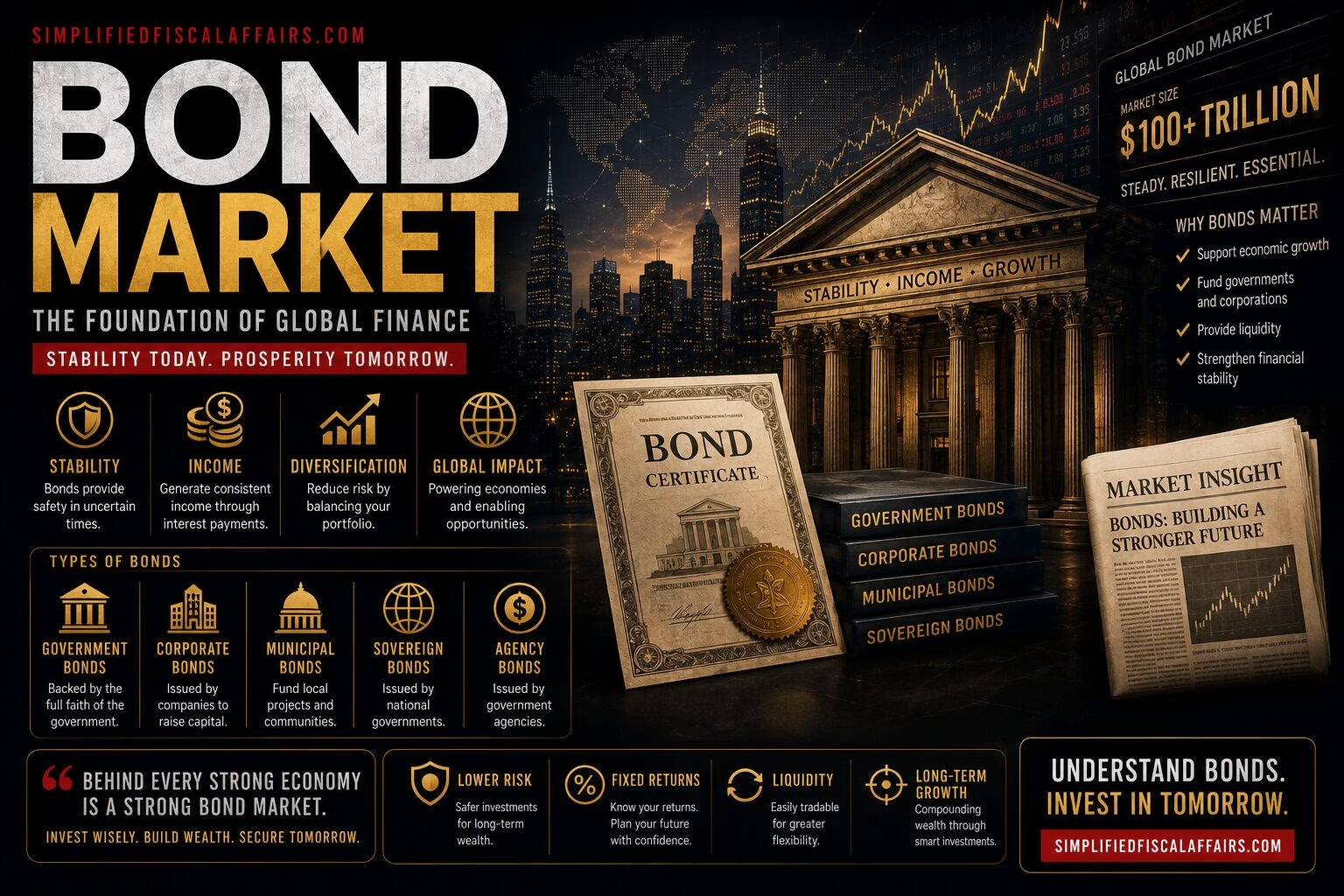
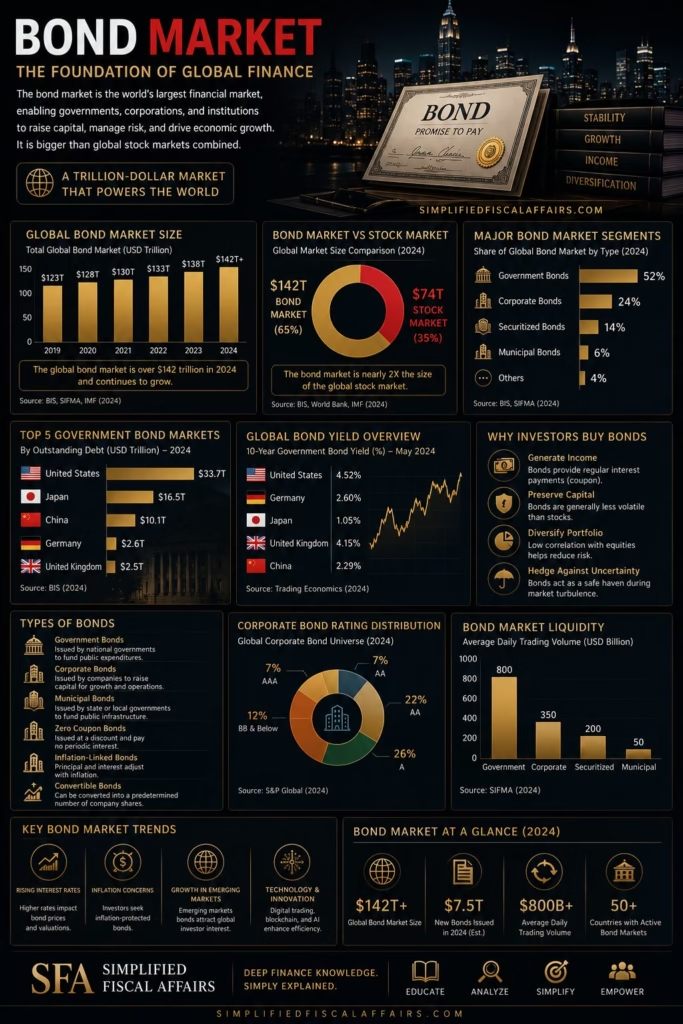
Why the World’s Largest Financial Market Controls the Global Economy
“The stock market may dominate headlines, but behind every government budget, corporate expansion, infrastructure project, and central bank decision lies a financial giant that quietly moves trillions of dollars every year—the global bond market.”
Introduction: The Financial Giant Hidden in Plain Sight
Imagine walking into the world’s largest marketplace. Instead of people buying smartphones, cars, or shares of famous companies, governments, multinational corporations, banks, and institutional investors exchange promises—promises to repay borrowed money with interest.
These promises are called bonds.
While stock markets capture the public’s attention with dramatic rallies and crashes, the bond market operates with far less publicity despite being significantly larger. Every day, governments finance schools, hospitals, highways, military operations, renewable energy projects, and public services by issuing bonds. Corporations fund research laboratories, build factories, acquire competitors, and expand internationally through the same mechanism.
The bond market forms the financial backbone of the global economy. It influences mortgage rates, business loans, corporate investments, pension funds, insurance companies, and even the interest rate on a family’s home loan. When economists discuss inflation, recessions, or monetary policy, they are often describing forces that directly affect the bond market.
Understanding bonds is therefore not just for investment professionals. Anyone interested in personal finance, business, economics, or investing benefits from understanding how this market works.
This comprehensive guide begins with the fundamentals and gradually builds toward advanced concepts, allowing readers with no prior financial knowledge to understand one of the most influential markets ever created.
By the end of this series, you will understand:
- Why governments borrow instead of printing money.
- How bond prices and interest rates move in opposite directions.
- Why investors monitor bond yields every day.
- How central banks influence the economy through bond markets.
- Why the bond market often predicts recessions before stock markets react.
- How institutional investors manage trillions of dollars using fixed-income securities.
- Why the global bond market has become one of the most important pillars of modern finance.
Whether you are a student, investor, entrepreneur, finance professional, or simply curious about the global economy, understanding the bond market provides a foundation for making sense of countless financial events reported in the news.
In the chapters ahead, we will explore the origins of bonds, the evolution of debt markets through history, the mechanics of bond investing, the relationship between interest rates and prices, the role of central banks, and the future of global fixed-income markets in an increasingly digital financial system.
Welcome to the world’s largest financial market.

“The Market That Quietly Runs the World”
When most people think about financial markets, they imagine flashing stock tickers, famous companies, and billionaires ringing the opening bell at a stock exchange. Television channels report daily movements of stock indices, social media celebrates soaring technology shares, and newspapers devote front pages to stock market rallies or crashes.
Yet behind all this excitement exists a market that is even larger, more influential, and arguably more important to the functioning of the global economy.
It is the bond market.
Unlike the stock market, the bond market rarely attracts widespread public attention. It operates largely behind the scenes, connecting governments, corporations, banks, pension funds, insurance companies, and institutional investors in a vast network of lending and borrowing.
Every time a government builds a new highway, constructs an airport, expands a railway network, finances healthcare, modernizes its military, or invests in renewable energy, there is a good chance that bonds played a crucial role in funding the project.
Similarly, when multinational corporations build factories, launch research initiatives, acquire competitors, or expand into new countries, they frequently raise capital by issuing bonds rather than selling additional shares.
Without the bond market, modern economies would struggle to finance long-term development. Infrastructure would grow more slowly, businesses would have fewer financing options, and governments would face greater difficulty responding to economic crises or natural disasters.
More Than Just “Borrowing Money”
At its core, a bond is remarkably simple.
Imagine you lend ₹10,000 to a trusted friend. Instead of making a verbal promise, your friend writes a formal agreement:
“I promise to repay ₹10,000 after five years and pay you 8% interest every year until then.”
That written promise closely resembles a bond.
The bond market scales this same principle from thousands of rupees to billions—or even trillions—of dollars.
The borrower might be:
- A national government
- A state or local authority
- A multinational corporation
- A development bank
- An international financial institution
The lender might be:
- An individual investor
- A pension fund
- An insurance company
- A mutual fund
- A commercial bank
- A sovereign wealth fund
- Another government
Although the amounts involved are vastly larger, the underlying idea remains the same: one party needs capital today, and another party is willing to provide it in exchange for future repayment with interest.
Why the Bond Market Is Larger Than the Stock Market
Many new investors assume the stock market represents the center of global finance because it receives the most media attention.
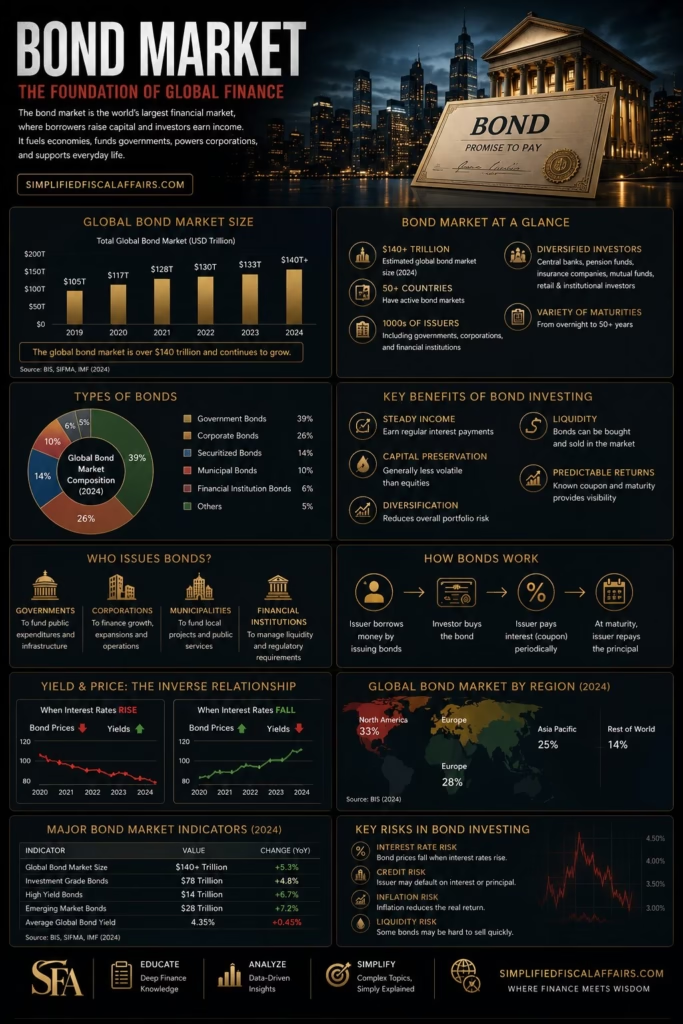
In reality, the bond market often surpasses the stock market in size.
Why?
Because nearly every major institution depends on debt financing.
Governments borrow to fund public services without immediately raising taxes. Corporations issue bonds to finance expansion while allowing existing shareholders to retain ownership. Banks purchase bonds to manage liquidity, diversify assets, and satisfy regulatory requirements. Pension funds and insurance companies rely on bonds to generate predictable cash flows needed to meet long-term obligations.
This constant cycle of borrowing and lending has created a market worth well over one hundred trillion dollars globally, making it one of the largest financial markets ever developed.
Its scale reflects the central role of credit in the modern economy. From local infrastructure projects to international development, bonds help channel savings into productive investment.
Why Governments Borrow Instead of Printing Money
A common question is:
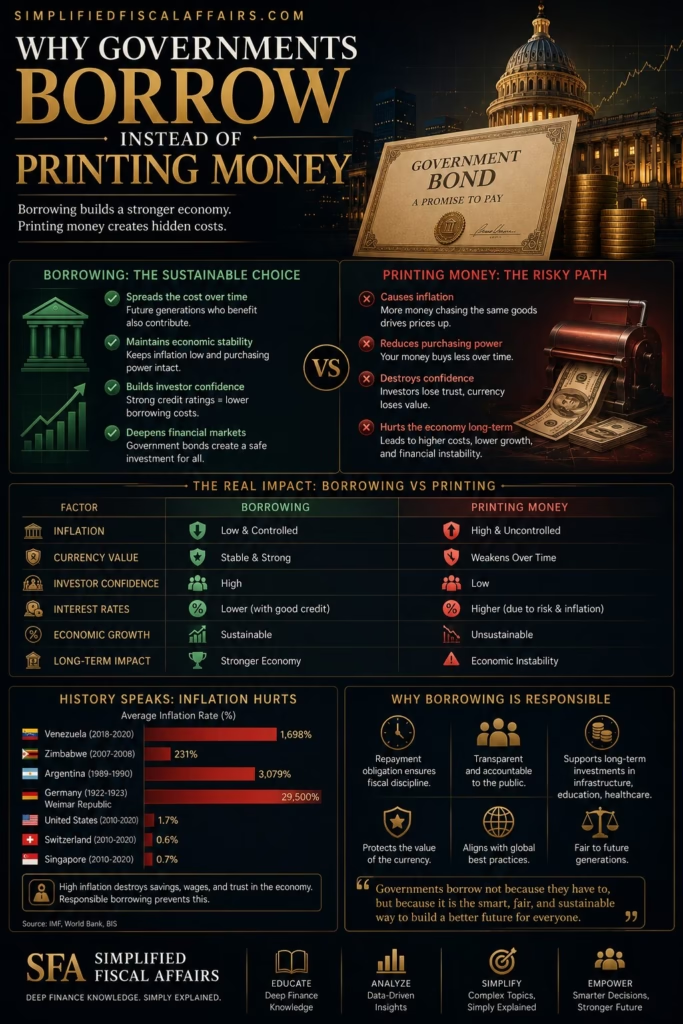
“If governments can print money, why do they issue bonds?”
The answer lies in economic stability.
Printing excessive amounts of money increases the money supply. If the supply of goods and services does not rise at the same pace, prices tend to increase, reducing the purchasing power of households and businesses. Persistent overuse of money creation can contribute to high inflation or, in extreme cases, hyperinflation.
Borrowing through bonds provides governments with a different mechanism. Investors voluntarily lend funds with the expectation of repayment and interest, allowing governments to finance spending while operating within established fiscal and monetary frameworks.
The balance between taxation, borrowing, and money creation is one of the most important challenges in public finance, and the bond market sits at the heart of that balance.
Bonds Build the World Around Us
Many people assume bonds exist only on trading screens or in financial institutions.
In reality, they often finance the infrastructure and services we use every day.
Examples include:
- Highways and bridges
- Metro rail systems
- Airports
- Public hospitals
- Schools and universities
- Renewable energy facilities
- Water treatment plants
- Telecommunications infrastructure
- Affordable housing projects
When you travel on a modern expressway or pass through a newly expanded airport, there is a reasonable chance that long-term borrowing through bonds helped make the project possible.
In this sense, the bond market is not an abstract financial concept—it is closely connected to everyday economic development.
A Foundation for Modern Finance
The bond market also influences many financial decisions beyond large-scale projects.
Interest rates on mortgages, business loans, corporate borrowing, and even some consumer loans are shaped by conditions in bond markets. Investors monitor government bond yields as indicators of inflation expectations, economic growth, and confidence in fiscal policy.
For this reason, economists, central banks, businesses, and professional investors pay close attention to bond markets even when public attention is focused elsewhere.
Understanding bonds is therefore not just about learning another investment product. It is about understanding one of the mechanisms through which capital moves across the global economy.
Summary
The bond market may not generate the same headlines as the stock market, but it plays a fundamental role in financing governments, supporting businesses, and enabling economic development. By connecting borrowers who need capital with investors seeking reliable returns, it helps allocate resources across the economy.
As you continue through this guide, you will discover that every bond carries a story—of a government funding public services, a company pursuing growth, or an investor seeking stability. Understanding these stories provides valuable insight into how the global financial system operates.
Next Chapter →What Exactly Is a Bond? – II
SERIES 2 – What Exactly Is a Bond?
Understanding the World’s Simplest Financial Promise
“Every bond begins with a simple promise: ‘Lend me money today, and I’ll repay you tomorrow—with interest.'”